

Top 10 Puff Snack Food Production Lines: Your Ultimate Guide
2026-05-09
Snack time just got a serious upgrade, and puff snacks are leading the charge. If you're serious about scaling your production, you need more than just machinery—you need a line that delivers speed, consistency, and that perfect melt-in-your-mouth texture. That's where choosing the right puff snack food production line becomes a game-changer. In this guide, we're breaking down the top 10 lines that dominate the market, with a spotlight on innovation from MINGDE, a name trusted worldwide for turning snack dreams into reality. Ready to find your perfect match?
What Sets Apart Modern Puff Extrusion Systems
The underlying architecture of contemporary puff extrusion lines has shifted dramatically toward integrated, closed-loop control. Instead of relying on manual tweaks to barrel temperatures or screw speeds, these systems actively sense variances in melt pressure and viscosity in real time. When a deviation occurs, the control logic instantly adjusts heating zones or drive RPM to maintain exact product density and texture, something older setups simply couldn't do without constant operator intervention.
Another noticeable leap lies in screw design and metallurgy. Modular screw elements with refined mixing sections now handle a far broader range of raw materials, from high-fiber flours to protein blends, without excessive shear or wear. The barrels aren't just heated; they're precision-cooled with circulated fluid systems, preventing heat buildup that once caused irregular expansion and scorched notes in the final snack. This level of thermal control allows for much higher throughput while keeping the extrudate uniform.
Ease of maintenance and hygiene has also been rethought from the ground up. Modern machines often feature slide-away barrels and quick-release die assemblies that dramatically cut down changeover time, making short production runs economically viable. Combined with data logging that tracks every parameter shift across batches, operators can spot wear trends early and schedule upkeep before a line halts unexpectedly. These practical refinements, more than any single technological breakthrough, set modern puff systems apart from their predecessors.
Material Blends That Shape Texture and Taste
The magic often starts with a surprising duo: almond flour and tapioca starch. When toasted almond flour meets the chew of tapioca, they create a crumb that's both tender and resilient—ideal for cookies that bend before they break, leaving a whisper of nuttiness on the tongue. It's the kind of blend that feels familiar yet resists cliché, because the tapioca pulls moisture into pockets of springiness while the almond flour keeps things grounded with its subtle grain.
Then there's the playful friction between rye and rice. Coarse rye brings an earthy, almost brash texture, studded with bran flakes that crackle under the teeth, while fine rice flour swoops in to soften the bite, adding a silkiness that coats rather than attacks. Together they dance in a cracker or shortbread, offering a contrast that wakes up the palate—rustic and polished all at once, no single note dominating.
For something that truly surprises, consider coconut flakes paired with green banana flour. The coconut brings fibrous shreds that catch and char at the edges during baking, releasing bursts of tropical fat, while the green banana flour lends a velvety density that holds structure without heaviness. It's a combination that turns a simple flatbread into an experience—crisp, then giving, with an aftertaste that hints at warmth and caramelized fruit, never predictable.
Precision in Die Design and Cutter Configuration
The art of die design lies in the seamless marriage between material behavior and tool geometry. Every curve, clearance, and cutting angle must be tailored to the specific stock, thickness, and grain direction to prevent buckling or tearing. Even a fractional misalignment in the cutter path can cascade into edge burrs, dimensional drift, or excessive tool wear. Precision here isn’t just about tight tolerances—it’s about anticipating how metal flows under pressure and designing the die to guide that flow with surgical accuracy.
Cutter configuration plays an equally critical role, often dictating the rhythm and economy of the entire stamping operation. The sequence of punches, pilots, and trimming stations must balance material utilization against die strength, ensuring that the strip advances smoothly without buckling. Advanced setups now integrate staged cutting—roughing, semi-finishing, then final profiling—to distribute cutting forces and extend tool life. The result is a quieter press, sharper edges, and a dramatic reduction in snap-through shock that can otherwise fatigue the die structure over time.
What truly separates exceptional work from the merely adequate is the willingness to iterate on cutter geometries and die coatings based on real-world wear patterns. For instance, adding a shallow shear angle to a punch might seem trivial, but it can slash tonnage requirements and eliminate the telltale ringing of a hard-hit press. Similarly, applying diamond-like carbon coatings to high-wear surfaces often yields an overnight improvement in part consistency. These details rarely appear in standard textbooks; they emerge from shop floor observation and a stubborn insistence on refining the process until every part drops freely and every edge remains crisp.
Energy Efficiency Without Sacrificing Throughput
The pursuit of lower energy consumption often brings to mind images of compromised speed or reduced output. In many systems, dialing back power seems like an inevitable trade-off—one that teams are hesitant to make when every millisecond counts. Yet, this needn’t be a zero-sum game. With thoughtful engineering, it’s entirely possible to shed excess energy use while keeping throughput firmly on track. The trick lies in moving past blunt-force throttling and toward smarter, more adaptive strategies that trim waste without touching peak performance.
Modern hardware and software stacks open the door to techniques that were once out of reach. For instance, dynamic voltage and frequency scaling can be tuned far more granularly than the typical on/off power profiles, adjusting in real time to workload demands rather than adhering to fixed ceilings. Similarly, intelligent load balancing across cores or nodes ensures that no unit idles wastefully while others are swamped. Memory access patterns, cache utilization, and even I/O scheduling play subtle but crucial roles—shaving off milliwatts here and there adds up without the user ever noticing a hiccup in responsiveness.
The beauty of this approach is that it doesn’t demand a radical overhaul. Incremental improvements in firmware, kernel parameters, or application-level orchestration can yield surprising gains. Teams that treat energy as a first-class design parameter, rather than an afterthought, discover that efficiency and throughput start to reinforce each other. Cooler operation often means less throttling under sustained load, and leaner code paths reduce both cycle count and power draw. In the end, delivering full performance with a lighter footprint isn’t just an aspiration—it’s a practical reality that more systems are quietly achieving every day.
Real-Time Monitoring and Automation Upgrades
We used to rely on scheduled checks that often missed critical spikes in server load, leaving our team scrambling after the fact. With real-time monitoring, every metric is streamed live to customizable dashboards, so the moment a threshold is breached—be it memory usage, transaction latency, or failed logins—an alert goes out instantly. This shift turned our operations from reactive firefighting into proactive management, catching issues like a gradual memory leak before it escalated into an outage.
Automation upgrades reshaped how we handle deployments and routine maintenance. Manual steps that once consumed entire afternoons—like database backups, log rotation, or spinning up test environments—now happen automatically through scripts triggered by code commits or time-based rules. The result isn’t just speed; it’s consistency. Processes that previously risked human error now run identically every time, freeing engineers to tackle architectural challenges instead of babysitting cron jobs.
Bridging monitoring and automation created a self-healing loop. When real-time data flags a sudden traffic surge, the system no longer waits for a human to approve scaling; it programmatically adds resources and balances the load, all while logging every action. Conversely, if a non-critical service starts throwing errors, an automated rollback is initiated while the team investigates. This tight coupling means our infrastructure adapts dynamically, maintaining stability without constant human oversight.
Scaling Up While Keeping Product Consistency
When a product starts gaining traction, the pressure to ramp up production can feel like a double-edged sword. You want to meet demand, but not at the cost of what made the product work in the first place. The key isn't just adding more machines or more people—it's embedding consistency into the process from day one. That means documented steps, clear quality checkpoints, and a culture where every batch matters as much as the first one ever did.
One common mistake is assuming that scaling is just a logistics problem. It's actually a design challenge. If your recipe, codebase, or manufacturing workflow wasn't built with growth in mind, tiny variations compound fast. Over time, the product your new customer gets might be noticeably different from the one your early adopters fell in love with. Smart teams treat their production specs like living documents—updated when needed but always anchored to a non-negotiable definition of "done right."
Perhaps the hardest part is maintaining that consistency without stifling innovation. Scaling often brings new suppliers, new hires, and new tools—all potential sources of drift. The trick is to build feedback loops that catch deviations early, not after a customer complaint. Regular blind testing, automated monitoring, and a refusal to accept "close enough" are what separate brands that scale gracefully from those that lose their identity in the process.
FAQ
Puff snacks are light, airy snacks made by cooking dough under high temperature and pressure, which causes it to expand (or 'puff') rapidly as it exits the extruder. Unlike denser extruded products like pasta or certain crisps, puff snacks have a distinctively porous, crunchy texture because of the sudden moisture flash-off. They can be made from corn, rice, wheat, or multigrain blends and are often shaped into curls, balls, tubes, or rings.
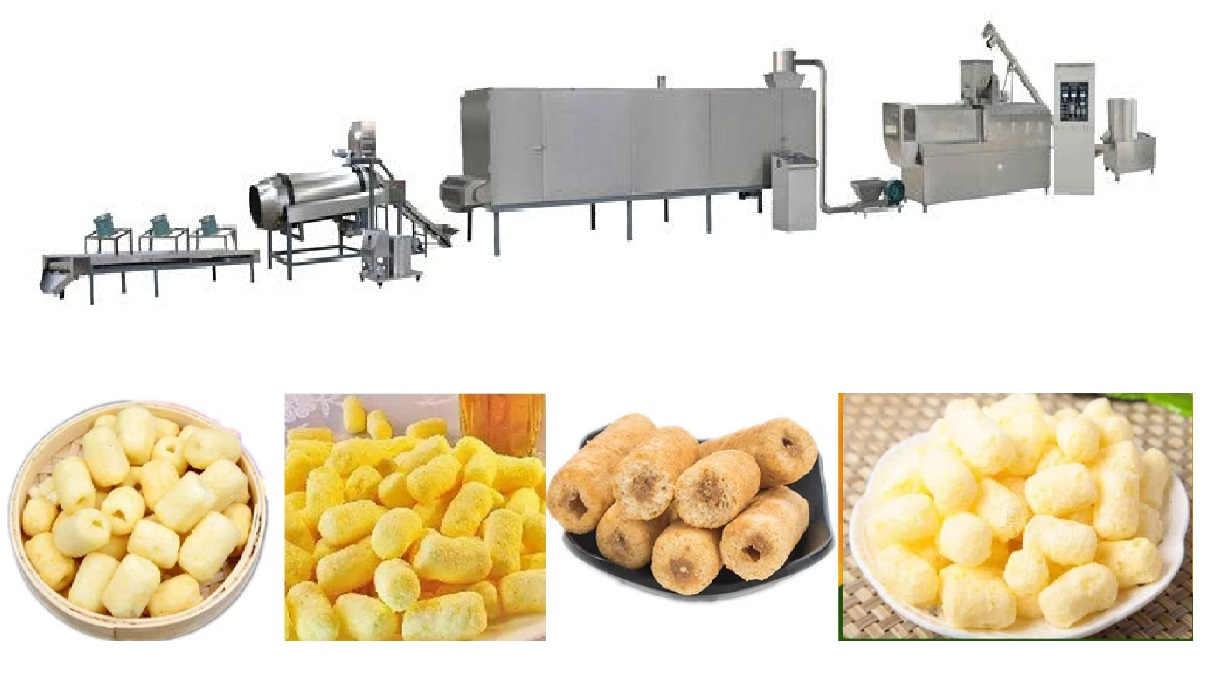
A typical line starts with a raw material handling system (silos, conveying, weighing), moves into a preconditioner where ingredients are mixed and pre-hydrated, then into a twin-screw extruder for cooking and shaping. After the extruder, you'll find a face cutter, followed by a drying or toasting oven to achieve the right final moisture. Finally, a seasoning system applies oils and powders before the snacks are cooled and sent to packaging machines. Some lines also integrate inline quality check systems.
Capacity needs depend on your target market and distribution scale. Small to mid-sized producers typically start with lines that output 100–300 kg per hour, which can still allow for growth. Larger industrial setups often go for 500–1000+ kg per hour. It's not just about hourly output—you should also consider the line's flexibility to switch between snack shapes and recipes without hours of downtime. A good practice is to project your sales volumes for the next 3–5 years and leave some headroom.
Frequent issues include uneven puffing (often due to moisture or temperature inconsistency in the extruder), excessive waste during start-ups, and cutter blade wear. These can be minimized by using ingredient formulations with stable moisture content, automated process controls that keep barrel temperatures within tight ranges, and scheduling preventive maintenance for blades and screws. Training operators to read the extruder torque and pressure curves also helps them react before a problem escalates.
Preconditioning partially hydrates and starts to cook the raw mix before it enters the extruder. If skipped or poorly controlled, the extruder has to work harder, which can lead to incomplete starch gelatinisation, inconsistent expansion, and higher mechanical wear. Proper preconditioning improves final texture, reduces energy consumption, and allows for shorter extruder barrel lengths, saving floor space and cost.
The drying oven stabilizes the snack's moisture content and sets its crunch. Freshly extruded puffs typically have a moisture content around 8–12% and must be brought down to 2–4% to achieve that shelf-stable, crispy bite. Skipping the dryer might work for very thin, highly expanded snacks that flash off enough moisture, but most commercial products require controlled, multi-zone drying to avoid case hardening or soft centers.
Versatility comes from interchangeable die plates and cutter combinations that form different shapes, along with adjustable screw configurations to alter dough rheology. For flavors, the bulk coating system can be cleaned between recipe changes (some lines use modular drum coaters), and liquid spray nozzles can apply distinct oil-based flavor mixes. Advanced lines store recipes digitally, so an operator simply selects the product name and the line auto-sets temperatures, screw speeds, and seasoning rates.
Beyond the base price, evaluate the supplier's experience with your specific recipe range, their after-sales support network, availability of wear parts, and willingness to conduct trial runs with your ingredients. A supplier that offers full line integration—from mixing to packaging—can reduce compatibility headaches. Visits to existing installations and talking to their operators often reveal the true ease of use and reliability.
Conclusion
Modern puff snack production has moved far beyond simple extrusion. The systems topping our list distinguish themselves through refined control over every stage, turning raw ingredients into precisely textured snacks. It starts with advanced extruders that manage shear, temperature, and pressure with unmatched accuracy, unlocking everything from delicate melts to hearty crunches. But hardware alone isn't the story—material blends are where creativity meets science. Subtle shifts in starch ratios, protein content, or moisture levels dramatically alter mouthfeel and flavor release, letting producers craft unique products that stand out on crowded shelves. Equally critical is die design and cutter configuration, where minute adjustments in orifice geometry or blade speed dictate shape uniformity and surface finish, minimizing waste while boosting visual appeal.
What truly elevates the best lines is how they balance relentless output with resource consciousness. Energy efficiency isn't an afterthought; it's baked into motor systems and thermal recovery loops, slashing costs without throttling throughput. This is paired with real-time monitoring suites that learn from every batch—automatically tweaking parameters to head off inconsistency before it happens. For growing brands, scalability is the final hurdle. Top-tier lines handle capacity jumps seamlessly because their core engineering ensures that the first kilogram matches the millionth. In our guide, we spotlight ten lines that embody this philosophy, each offering a distinct blend of innovation, reliability, and flexibility. Whether you're refining a classic cheese puff or inventing a whole new category, these systems provide the foundation for consistent, efficient, and market-leading production.
Contact Us
Contact Person: LILY SUN
Email: [email protected]
Tel/WhatsApp: 0086-13969103791
Website: https://www.snackfoodmachinery.com/