

Substantial Preserved Moss Ideas for a Lush Indoor Garden
2026-10-05
Most people think a lush indoor garden means daily watering and bright light—until they meet preserved moss. It brings that deep green, forest-floor feel without the upkeep, and it can be styled into substantial statement pieces. At PHLEEYA, we've collected a few favorite methods—from moss walls to sculpted spheres—that turn ordinary rooms into soft, green retreats. Here's where to start.
Turning a Blank Wall into a Moss-Covered Focal Point
Most blank walls stay invisible until you give them a reason to be noticed. Moss does this without shouting. A sheet of vivid green spread across a once-empty expanse immediately changes how the room feels—softer, quieter, a little more alive. Pick a wall that gets indirect light and stays relatively cool, because moss looks best when it can hold its color without drying out too fast.
The real trick is working with the wall’s existing texture instead of fighting it. You can mount preserved moss in modular panels, letting you create an irregular patchwork that follows the wall’s proportions rather than a rigid rectangle. Leave a few gaps so the original surface peeks through; that contrast keeps the installation from feeling like wallpaper. If you want a living version, a shallow frame with a moisture barrier and a fine misting routine will support sheet moss or cushion moss, but preserved moss will save you the hassle while still looking convincingly fresh.
Once it’s up, the moss becomes a quiet anchor for the rest of the room. Wood, brass, and linen all sit comfortably next to that deep green. You won’t need to fuss with it much—just dust it now and then, and if it’s living, give it a light spray every few days. The payoff is a wall that finally feels intentional, not just empty.
Mixing Preserved Moss with Reclaimed Wood and Stone
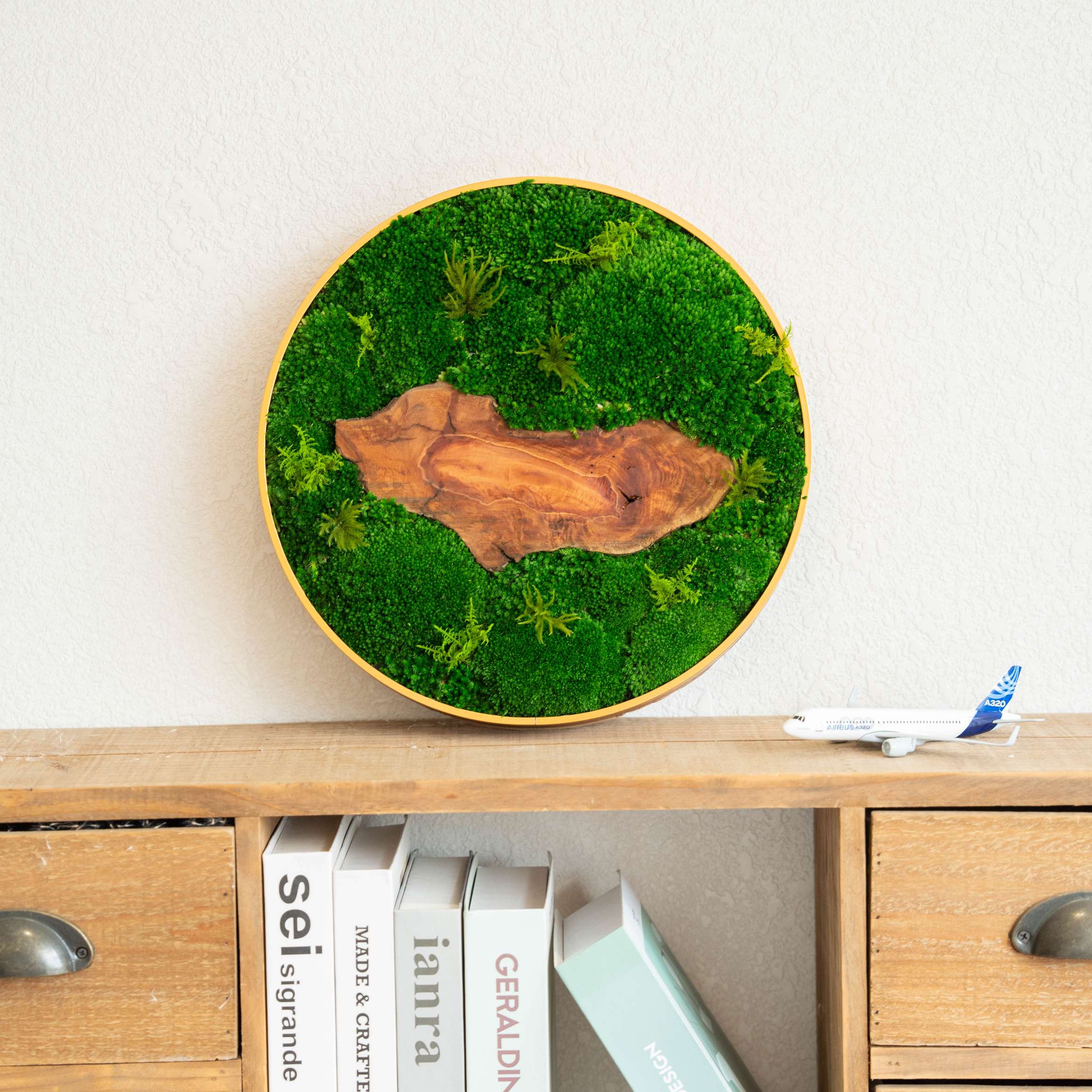
Pairing preserved moss with reclaimed wood and stone works because the materials argue with each other in a quiet way. The moss brings a low, uneven softness that makes the scars and saw marks in old timber feel more deliberate. A split in a beam or a nail hole doesn’t read as damage once a patch of green settles into it; the moss acts like a cushion between the wood’s history and the room’s present tense.
Stone pulls the combination in a different direction. A single piece of honed slate or a rough chunk of fieldstone gives the arrangement weight, so the wood doesn’t float and the moss doesn’t feel like an afterthought. You don’t need much stone—a ledge, a plinth, a few river rocks tucked under a reclaimed shelf—to stop the eye from sliding past the texture. The coolness of the stone also keeps the preserved moss from reading as too soft or artificial.
When you build with these three, think less about symmetry and more about where the light lands. A strip of moss running alongside a dark walnut plank looks different at noon than it does under a single warm bulb at night, and that shift is what makes the mix feel alive. Because the moss is preserved, you aren’t tied to watering schedules or drainage trays, so you can place it in spots where real plants would fail: inside a shallow wall niche, across the top of a stone-topped bench, or wedged into the gaps of a reclaimed beam.
Designing a No-Fuss Moss Centerpiece for Your Table
A low, wide bowl or a simple wooden tray works best for this kind of arrangement. Press a layer of damp sheet moss into the base, letting it spill slightly over the edges for an organic feel. Then tuck in small ferns, a few smooth stones, and maybe a single branch of lichen-covered twig. No need for floral foam or hidden mechanics—just let the moss hold everything in place.
Keep the palette restrained: soft greens, muted grays, and one quiet accent like a pale candle or a tiny glass cloche. Mist the moss lightly every couple of days, and it will stay fresh for weeks. This centerpiece doesn't demand perfect symmetry or rare plants. It simply borrows a patch of woodland calm and sets it down among the dinner plates.
Softening Sharp Edges with Clusters of Cushion Moss
Cushion moss earns its name from the way it grows into tight, domed clusters that read as soft green pillows against rock. When tucked into the seams of a granite step or wedged at the base of a retaining wall, those rounded clusters interrupt the straight lines and sharp corners that otherwise dominate hardscape. The effect is subtle but immediate: a path that previously felt rigid starts to look settled, as if the stones have been there long enough for the landscape to embrace them.
This works especially well on edges that people brush past or sit near. A low border of cushion moss along a concrete walkway or around a sharp-edged planter softens the visual boundary without adding height that would block foot traffic. Because cushion moss stays compact and slow-growing, it won’t sprawl over the stone or require constant trimming. Instead, it holds its clumping form, gradually filling small crevices until an abrupt corner becomes a gentle curve of green.
Playing with Moss Textures to Add Visual Depth
Moss rarely sits still. It creeps over bark, spills across stone, and softens every edge it touches, so working with its texture feels less like decorating and more like letting a quiet layer of life settle into a space. Moss builds visual depth through the way light plays across the tiny leaves, some catching a bright sheen while others fall back into shadow, creating a surface that shifts as you move past it.
To push that depth further, mix mosses with different heights and growth habits. A low, velvet-like sheet moss next to a wispy fern moss or a tufted cushion moss will break up the surface and give the eye multiple resting points. Dry moss can hold its color and form for years, but if you introduce a patch of living moss, the subtle moisture differences add another layer, darker where damp, lighter where air circulates.
Placement matters just as much as the material itself. Set moss into a crevice, angle it so one side catches the light, or layer it over a rough stone base. The irregular shadows that form between clumps become part of the composition, and that unplanned variation is what makes the finished piece feel grounded rather than arranged.
Building a Cozy Reading Corner Around Moss Accents
A reading corner lives or dies by its textures, and preserved moss brings an unexpected softness that fabric alone rarely matches. Instead of covering an entire wall, try framing a single panel of cushion moss behind a low shelf or wrapping a narrow column beside your chair. The green reads as alive even in dim evening light, giving the space a quiet, grounded feel that makes it easier to settle in with a book.
Balance matters more than quantity. Pair the moss with warm, slightly worn materials—a wool throw, a wooden side table, a linen lampshade—so the corner doesn't feel like a terrarium. A small tray of reindeer moss on the armrest or a strip of sheet moss tucked into the base of a floor lamp can carry the theme without demanding attention. Keep the palette limited to deep greens, oat, and raw timber, and let the moss be the one element you actually want to touch.
Lighting changes everything. Position a small fixture so it grazes the moss surface from the side rather than hitting it straight on, which reveals the tiny ridges and shadows that make preserved moss feel less flat. If the corner sits near a window, a few hours of indirect sun will keep the color from looking artificial. Then add one comfortable chair, a footrest, and a ledge wide enough for a mug and a half-finished novel—nothing else needs to compete for your attention.
FAQ
Preserved moss retains its soft texture and rich green tones without needing soil, water, or sunlight. Because it is no longer photosynthesizing, you can place it in dark corners or air-conditioned rooms and it will still look freshly picked, which makes it ideal for maintaining that dense, jungle-like feel indoors.
Spread it across a large tray as a table centerpiece, but keep the container shallow and pair it with pale stones or light wood. You can also break up large panels with open spaces or mix in some dried grasses and air plants to keep the arrangement airy rather than overwhelming.
Absolutely. Many interior designers mount preserved moss onto rigid backing boards and create flowing, organic patterns that span entire walls. The key is to apply it in sections, overlapping clumps so there are no visible seams, and to vary the direction of the moss for a more natural, windswept look.
No, they do best in average indoor conditions. Avoid placing them in direct sunlight, which can bleach the color, and keep them away from very damp bathrooms or steamy kitchens, since excess moisture can cause the glycerin-treated moss to sweat or lose its shape.
Reindeer moss and cushion moss are popular for their plump, rounded forms and come in several dyed shades. For a softer, more natural texture, sheet moss works well as a base, while Spanish moss adds a wispy, hanging element that makes the display feel more dynamic.
Yes, but keep them separate in their own containers or delineated zones. Living plants need water and soil, which can degrade preserved moss if they touch. Using a liner or raised tray lets you enjoy the low-maintenance moss as a backdrop while still caring for a few live ferns or pothos nearby.
Try lining the inside of a glass-topped coffee table, creating a moss 'rug' under a floating bench, or wrapping a column with irregular patches. You can also fill shallow wall niches or old picture frames with layered moss to turn unused corners into green focal points.
Dust it gently with a soft brush or cool hair dryer, and never water it. If the room gets very dry, a light misting of glycerin solution from a spray bottle can restore some suppleness, but it's usually better to leave it alone and keep it out of direct sun and high-traffic touching zones.
Conclusion
Preserved moss offers a surprisingly versatile way to bring a dense, evergreen feel indoors without the upkeep of living plants. One striking approach is turning an empty wall into a lush focal point by arranging sheets or panels of moss in layered, organic patterns—this instantly softens the room and draws the eye. Combining moss with reclaimed wood and rough stone adds warmth and texture, creating a natural vignette that feels both rustic and refined. For smaller spaces, a simple table centerpiece built around cushion moss and a few sculptural stones or driftwood pieces delivers a no-fuss touch of green that needs zero watering or sunlight.
Beyond standalone displays, preserved moss works beautifully as a design accent. Clusters of cushion moss tucked along the edges of shelves, staircases, or built-in furniture help blur harsh lines and make the whole interior feel less rigid. Playing with different moss textures—from fine, feathery sheet moss to plump, rounded reindeer moss—introduces subtle depth and encourages the eye to wander. Even a cozy reading corner can be transformed by framing it with moss panels or small moss-filled vessels, creating a quiet, enveloping atmosphere. Together, these ideas prove that substantial preserved moss arrangements can turn any room into a surprisingly lush, low-maintenance indoor garden with real character.
Contact Us
Contact Person: Mr. Luo
Email: [email protected]
Tel/WhatsApp: 86 18100895505
Website: https://www.feiliyaflowers.com/en/