
Stainless Steel Self Tapping Screws Distributor: What Buyers Need to Know Before Ordering
2026-11-16
Before you place another order for stainless steel self tapping screws, consider how many failures trace back to distributor shortcuts rather than the fastener itself. Material inconsistencies, incomplete heat treatment, or mismatched drill points can quietly undermine product performance—and your reputation. Wanluo has built its distribution model around eliminating those blind spots, and the following buyer's guide covers the questions to ask and red flags to avoid.
Not All Stainless Steel Is the Same
Walk through any commercial kitchen or marina and you'll see the same assumption at work: if it's stainless, it won't rust. That assumption collapses the moment you compare a cheap refrigerator panel to a marine railing after two seasons of salt spray. Stainless steel isn't one material but a whole family of iron-based alloys, each with different amounts of chromium, nickel, molybdenum, and carbon. Those differences quietly decide whether a surface stays bright or develops tea-colored stains, pits, or even cracks.
The workhorse 304 grade handles indoor humidity and occasional splash, but it struggles near coastlines or in pools because chlorides attack its passive layer. That's where 316 earns its higher price: the addition of molybdenum helps it shrug off salt and many chemicals. On the lower end, 430 costs less and resists mild acids, yet it will rust faster and is magnetic, which can surprise anyone who thinks all stainless should be non-magnetic. Then there are hardenable grades like 410, often used for cutlery, which hold an edge but sacrifice some corrosion resistance in return.
The real difference shows up in details no one advertises. A handrail by the ocean, a food-processing tank cleaned with aggressive sanitizers, or an exhaust system exposed to road salt all need a grade chosen for that specific environment. Buying just "stainless steel" without naming the grade is like buying "metal" for a bridge. The material is only as good as the match between its recipe and the conditions it will actually face.
Thread Type and Point Style Decide the Job
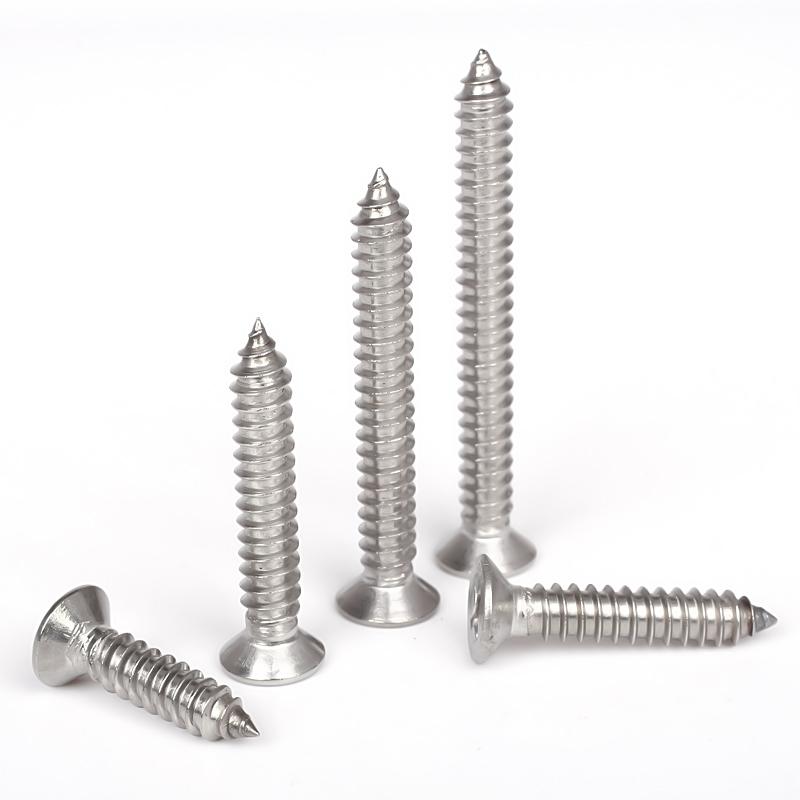
Most people never look closely at a screw until it fails. The wrong thread type can snap under load or strip out the material you are fastening into. Coarse threads usually bite better in soft wood or plastic, while fine threads give you more holding power in metal. If you grab a drywall screw for a hardwood project, the shank may shear before the head even seats.
Point style matters just as much as the threads. A sharp self-drilling point saves time on thin sheet metal, but it can wander on dense hardwoods. A blunt or type B point works well for softer materials, yet it needs a pilot hole in anything brittle. Pairing the right point with the thread profile keeps the screw from splitting the workpiece or skating across the surface.
Before you pick up the drill, run your thumb over the threads and check the tip. That small detail determines whether the joint holds for ten years or loosens in ten weeks. Different jobs demand different combinations, and there is no universal screw that does everything well. Match both features to the material, and the rest of the assembly gets a lot easier.
Head and Drive Choices Change Assembly Speed
Changing the drive recess alone can add or remove seconds from every fastening cycle. A Phillips recess is built to slip once torque gets high, which means the bit lifts off, the operator re-seats it, and the screw may need a second pass. Switching to a Torx or hex socket keeps the bit locked in at higher torque, so the driver doesn't bounce out and the screw seats on the first attempt. That small difference compounds fast when a workstation repeats the same motion all shift.
Head shape plays a quieter role but still moves the needle. A flat countersunk head can help center the fastener in a pre-drilled taper, yet it adds a countersinking step if the part isn't already prepared. A pan head with an integrated washer face removes the need to place a separate washer and sits flush against the surface without extra prep. Low-profile heads can also clear tight tooling, letting the operator drive at a better angle instead of fighting the workpiece.
Pairing the right head and drive does more than reduce cam-out or fumbling. It shortens the pick-and-seat time, reduces rework from stripped recesses, and lets automated feeding run without jams from inconsistent head geometry. On a line running a few thousand assemblies per shift, cutting even two or three seconds per fastener translates into a noticeable gain in daily output without adding headcount or speeding up the motor.
Coating and Passivation Are Separate Conversations
Many engineers treat coating and passivation as interchangeable steps, but they answer different questions. Coating is about covering a surface with a foreign layer—paint, polymer, or ceramic—to block moisture or abrasion. Passivation, on the other hand, is a chemical alteration of the metal itself, typically forming a thin oxide film that reduces reactivity. One adds material; the other transforms what is already there.
The confusion often comes from shared goals like corrosion resistance, but the mechanisms diverge sharply. A coating can fail by peeling or cracking, exposing the base metal. Passivation, being integral to the surface, has no interface to delaminate—though it can be scratched through. Choosing between them isn't a matter of better or worse, but of matching the failure mode you can tolerate.
In practice, the two are sequenced rather than substituted. Stainless steel is passivated first to build a self-healing oxide layer, then coated only if the environment demands extra barrier protection. Treating them as one conversation leads to specs that specify a coating when passivation alone would suffice, or passivation when a physical barrier is the real requirement.
Lead Times and Lot Traceability Should Be Verified
Before committing to a supplier, request written confirmation of current lead times for the specific components you plan to order. Many factories quote ideal turnaround windows that quietly stretch once production pressure mounts, especially during peak seasons or after raw material shortages. Ask for historical delivery data or recent shipment records to see whether promised dates match what past buyers actually experienced.
Lot traceability matters most when a defect appears after delivery. Verify that the supplier can trace materials back to individual production batches, including raw material sources, machine operators, and quality inspection notes. A clear batch-coding system and accessible records make it possible to isolate faulty goods without recalling an entire shipment.
Finally, require the supplier to share their internal process for notifying clients about delays or batch-level quality deviations. If they hesitate to explain how they monitor lead times or maintain traceability logs, treat that as a warning sign rather than a minor paperwork gap.
Questions to Ask Before Signing the Order
Never rush into a purchase without clarifying exactly what you're agreeing to. Start by confirming the total cost, including any hidden charges like shipping, handling, or recurring fees that might not appear in the initial quote. Ask whether the price is locked or subject to change, and find out what happens if you need to cancel or modify the order after signing.
Next, dig into the delivery timeline and what happens if the product arrives damaged or doesn't match the description. Request a written copy of the warranty or return policy, and don't be afraid to ask how disputes are resolved—whether through mediation, arbitration, or small claims court. Knowing who to contact for support after the sale is just as important as the signature itself.
Finally, verify that the seller has the legal right to sell the item or service, especially for high-ticket purchases or customized orders. Ask for references, licensing information, or proof of insurance if applicable. A few pointed questions upfront can save you from costly surprises and buyer's remorse down the road.
FAQ
304 offers better corrosion resistance and works well outdoors or in damp environments, while 410 is harder but less resistant to rust, so it suits indoor or lightly exposed applications where higher strength matters more.
For thin sheet metal, look for fine threads with a sharp point, often labeled as Type A or AB. They bite quickly without needing a pilot hole and reduce the chance of stripping the material.
Most distributors source from different mills and finishing lines. Some carry stock and can split boxes, while others only sell full cartons or production runs, so the MOQ reflects their inventory model and packaging setup.
Ask whether the coating is applied in-house or outsourced, how many hours of salt spray it can pass, and if it affects the threads' fit. Zinc plating, Ruspert, and plain passivated finishes all behave differently in the field.
Many distributors keep semi-finished blanks and can cut or roll threads to custom lengths fairly quickly, but special head styles or drive recesses usually require a production run. Always confirm the lead time for each modification instead of assuming it is stock.
Ask for a material test report or mill certificate showing the grade chemistry, a certificate of conformance, and plating thickness or salt spray results if corrosion matters. If they cannot provide these, treat the lot as unverified.
Specify the exact assembly conditions and whether you need a bonded washer, a separate washer, or just the screw. Distributors sometimes default to assembled sealing washers for self tappers, which adds cost if your design does not require a seal.
Yes, but the range should stay within the standard you ordered, such as DIN or ASME tolerances. If your application is sensitive, ask for a dimensional inspection report or request a pre-shipment sample before accepting the full quantity.
Conclusion
Before you commit to a stainless steel self tapping screw order, recognize that the material grade matters just as much as the dimensions. A distributor might list "stainless steel" but that could mean 304, 316, or a lower-cost 410. For humid, coastal, or chemical-heavy environments, 316 gives better corrosion resistance, while 304 is fine for general indoor use. The thread type and point style also decide whether the screw will actually drive cleanly into the base material. Thread-forming screws create their own mating threads in softer metals or plastics, while thread-cutting styles are needed for harder substrates. If you skip this check, you risk stripped holes, cracked bosses, or field failures. Head style and drive recess affect assembly speed too: a hex washer head works well for high-torque applications, while a countersunk flat head suits flush finishes, and a Torx or square drive reduces cam-out on the line.
Coating and passivation are not interchangeable. Passivation is a chemical treatment that removes free iron and enhances the natural chromium oxide layer; it does not add a visible layer. If you need extra lubrication or a colored finish, ask about a coating, but confirm that it won't interfere with conductivity or food-contact requirements. Lead times can stretch when distributors rely on overseas mills, so request a written production schedule and ask whether the lot can be traced back to the melt source. Some buyers only learn this after a batch fails salt spray testing. Before signing, ask the distributor to provide mill certificates, confirm the exact grade and passivation method, specify the point style for your pilot hole size, and state the drive type and head dimensions. A few minutes of clarification up front prevents returns, line stoppages, and warranty disputes later.
Contact Us
Contact Person: Shane
Email: [email protected]
Tel/WhatsApp: 8613357785029
Website: https://www.wanluohardware.com