
Stainless Steel Hex Nuts Solutions for Corrosion-Resistant Assemblies
2026-11-16
Corrosion doesn't announce itself—it just waits for the weakest link. In many assemblies, that weak link is a standard hex nut, quietly degrading until the whole joint fails. Wanluo flips the script with stainless steel hex nuts built for corrosion-resistant performance, from coastal salt spray to chemical washdowns. Here's why swapping ordinary nuts for these precision-engineered solutions can save your assembly before rust ever gets a foothold.
Why Stainless Hex Nuts Resist Rust When Plated Fasteners Fail
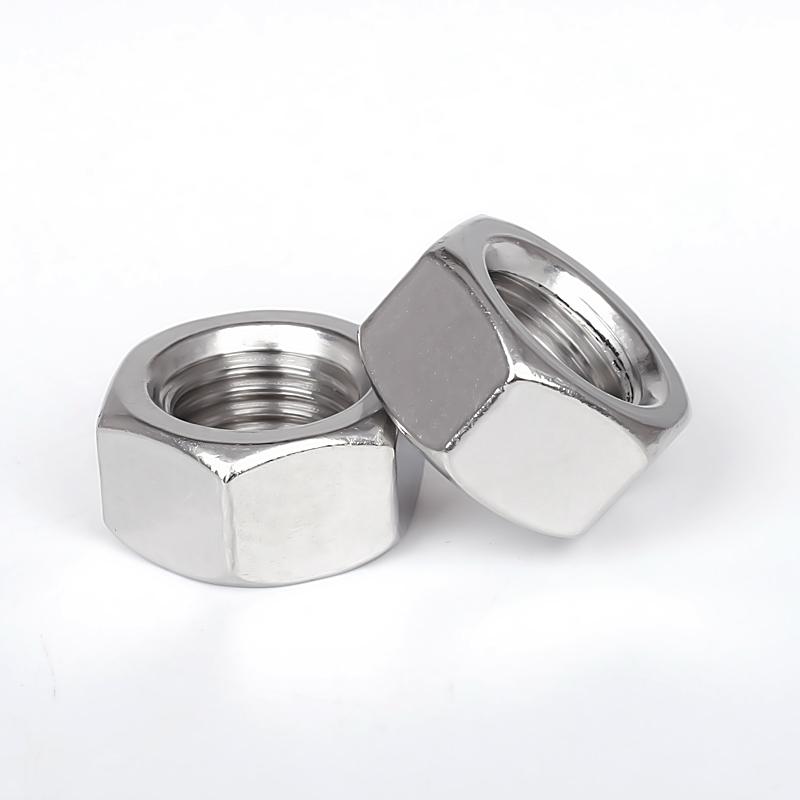
Stainless hex nuts resist rust because the chromium in the alloy forms a thin, self-repairing oxide layer on the surface. This passive film blocks oxygen and moisture from reaching the base steel. Plated fasteners, by contrast, depend on a separate metallic coating that is far thinner and more easily damaged.
If a plated fastener is scratched or its threads are nicked during installation, the underlying carbon steel is exposed and rust begins almost immediately. A stainless hex nut can suffer the same physical damage, but the exposed area still contains enough chromium to regenerate its protective oxide layer.
Over time, edges, threads, and contact points on plated fasteners tend to lose their coating first. Stainless hex nuts remain corrosion resistant through the entire cross-section, so they hold up better in wet, salty, or industrial environments where plated fasteners fail shortly after the plating wears away.
Choosing the Right Stainless Alloy for Salt Spray and Acid Exposure
Salt spray testing often gets treated as a universal badge of corrosion resistance, but a 304 panel that survives a few hundred hours in a fog chamber can still pit quickly in a coastal industrial environment. For chloride-heavy atmospheres, look past the base chromium content and focus on molybdenum and nitrogen. Grades like 316L offer a modest improvement over 304, yet real marine exposure usually demands 2205 duplex or a 6% molybdenum superaustenitic such as 904L or 254 SMO. The rule of thumb is straightforward: if the service environment combines salt with elevated temperature or crevices, multiply your safety margin rather than relying on a single salt spray result.
Acid exposure changes the selection logic entirely. Oxidizing acids such as nitric can be handled well by high-chromium ferritic or standard austenitic grades, whereas reducing acids like hydrochloric or dilute sulfuric attack the passive film in a different way and call for nickel-rich or copper-bearing alloys. Temperature and concentration matter more than alloy family alone; a material that holds up in 10% sulfuric at room temperature may corrode rapidly at 60°C or when the acid becomes contaminated with chlorides. Pilot testing with the actual process stream beats generic immersion data, because trace species often dictate whether a grade remains passive or loses its footing.
When both salt spray and acid exposure overlap—think coastal chemical plants or pickling lines—a single "corrosion-resistant" label won't save you. Duplex grades such as 2507 blend high strength with strong pitting resistance, while nickel alloys like C-276 are reserved for the most aggressive reducing-acid plus chloride environments. The practical way to choose is to rank the threats: if halides dominate, optimize for pitting and crevice resistance; if low pH dominates, prioritize uniform corrosion resistance and check for sensitization. Then validate the shortlisted alloys under conditions that mirror the worst-case temperature, aeration, and contamination expected in service.
What Passivation Actually Does for Hex Nut Longevity
Most hex nuts start with a clean surface, but machining and cold forming leave traces of free iron, tooling residue, and microscopic burrs. Passivation uses an acid bath to dissolve those contaminants rather than coating over them. For stainless steel nuts, the real payoff is what happens next: with surface iron gone, chromium can react with oxygen to form a thin, continuous oxide layer. That layer is only a few nanometers thick, yet it blocks the kind of localized attack that turns a perfectly good fastener into a rusty, seized mess.
Over time, that difference adds up. A passivated hex nut resists pitting in wet or salty conditions and is less likely to develop crevice corrosion where the nut meets the washer or flange. The passive film can even repair itself if scratched, as long as oxygen is present. Because it is a conversion process rather than a plating or paint, it does not change thread dimensions or alter hex drive tolerances. The nut still fits the way it should, but it keeps its clamping force and appearance far longer than an untreated counterpart.
Preventing Galvanic Corrosion in Assemblies with Dissimilar Metals
Galvanic corrosion occurs when two dissimilar metals are connected in the presence of an electrolyte, causing the more active metal to corrode at an accelerated rate. Before assembly, check the galvanic series and try to select metals that are close together in potential. Even a modest difference can be acceptable if the surface area of the more noble metal is kept small relative to the active metal, but reversing that ratio will quickly eat away the anodic component.
Where close potential matching is not possible, physical separation is the most reliable barrier. Use non-conductive gaskets, washers, or bushings to break the electrical path between the two metals. Apply protective coatings to both surfaces, but remember that a scratch or pinhole can expose the underlying metal and create a small anode with a large cathode, so coatings alone are rarely sufficient. In bolted joints, consider using fasteners made of a metal that is cathodic to both joined parts, or use an isolating sleeve under the bolt head.
Design details matter as much as material choice. Avoid trapped moisture by adding drain holes and sealing edges, especially in outdoor or marine environments. For assemblies that will be inspected or disassembled, choose a replaceable sacrificial component rather than letting corrosion attack the main structure. Finally, verify the protection strategy with a short-term exposure test or an electrochemical measurement if the operating environment is aggressive, because even well-planned material pairs can behave unexpectedly once contaminants enter the electrolyte.
Installation Torque That Protects Stainless Threads from Galling
Stainless steel fasteners are notorious for galling—a cold-welding effect that can seize threads before the joint ever reaches full clamp load. The single most effective safeguard is to keep installation torque within a controlled, moderate band. Run the nut down too fast or lean on the wrench too hard, and the surface oxides that normally separate the mating threads get scrubbed away. Once bare metal touches bare metal, microscopic high spots friction-weld instantly, and the assembly locks up permanently.
Accurate torque control starts with selecting a target below the yield point of the fastener, leaving enough margin for thread friction variation. For common austenitic grades like 304 and 316, dry assembly torque values often need to be reduced by 20–30% compared to carbon steel of the same size. A calibrated torque wrench is non-negotiable; impact drivers and unrestricted air tools invite galling because they spike torque faster than the thread surfaces can dissipate heat. Low-speed, steady pulls—never jerky bursts—help preserve the passive oxide layer that keeps stainless threads from seizing.
Lubrication works hand in hand with reduced torque. Anti-seize compounds or PTFE-based thread lubricants lower the friction coefficient and make the applied torque more predictable, so the same clamp load is reached with less surface damage. But be careful: lubricated threads require a lower torque value to avoid over-stretching the fastener. Whatever the method, the goal is the same—apply enough rotation to develop full preload while stopping well short of the point where galling takes over. Recording torque values during trial assembly and inspecting a few test joints can reveal whether the chosen setting actually protects the threads or just hides the risk.
Early Warning Signs Your Stainless Hex Nuts Are Losing Integrity
A faint brownish bloom near the edges or inside the wrench flats is often the first visible cue. On true stainless steel, this isn't ordinary rust but a breakdown of the passive chromium oxide layer, usually triggered by chloride exposure or surface contamination from carbon steel tooling. Once that layer starts to fail, the underlying metal can develop micro-pits that quickly deepen under load.
Another warning is a change in how the nut seats. If you notice the hex corners rounding after a single use, or if the nut no longer threads smoothly and wants to cross-thread, the material may be galling or work-hardening unevenly. Repeated tightening that requires more torque to reach the same clamp load often points to internal thread deformation rather than simple friction.
Cracks are rarely dramatic at first. Look for hairline lines radiating from the corners or the bearing face after vibration or thermal cycling. A stainless hex nut that has lost integrity may also feel lighter than expected or show a dull gray, etched surface where the protective finish has been chemically attacked.
FAQ
The chromium in the alloy forms a thin oxide layer that repairs itself when scratched. That passive film keeps rust from taking hold, so the nuts stay clean and strong in humid or splash-prone environments.
Most projects get by with 304, which handles mild dampness and oxidation well. If there is salt spray, chlorine, or chemical exposure, 316 is the better pick because the added molybdenum resists pitting.
You can, but it is usually a bad idea in wet locations. The two metals create a galvanic couple that accelerates corrosion on the carbon steel side. Pairing them with stainless bolts of a similar grade avoids that problem.
A little anti-seize on the threads makes a big difference. Also slow down, avoid power tools when possible, and do not overtighten. Mixing slightly different stainless alloys for the nut and bolt reduces the chance of seizing.
Yes, particularly 316 or A4 hardware. These grades handle salt air and periodic saltwater contact far better than zinc-plated carbon steel, though occasional rinsing with fresh water still helps extend life.
Check the grade marking on the fastener, confirm the dimensional standard matches your bolt, and look for a clean, uniform surface finish. Passivated or pickled nuts tend to have a more stable corrosion-resistant layer.
A2 is essentially 304, while A4 is essentially 316. For indoor or mildly damp use, A2 is fine. Go with A4 when you expect salt, acids, or constant moisture.
Usually yes, if the threads are intact and there is no heavy galling or pitting. A quick visual check and a test thread by hand will tell you whether they are still safe to reuse.
Conclusion
Stainless hex nuts hold up in wet and chemical-heavy assemblies because the alloy's chromium reacts with oxygen to form a self-healing oxide film. Unlike zinc-plated steel, which only has a thin sacrificial layer over carbon steel, stainless carries corrosion resistance through its entire cross-section. A scratch won't expose a rust-prone core. For salt spray or acid exposure, 316 stainless with molybdenum is a better bet than standard 18-8, as it resists pitting from chlorides. Passivation after machining removes iron particles and lets the chromium oxide rebuild, adding real service life. In mixed-metal joints, stainless can accelerate corrosion of aluminum or zinc if there's direct contact, so plastic or nylon washers and an anti-seize barrier keep the pair electrically isolated.
Thread galling is a bigger threat than rust in many stainless hex nut installs. When nut and bolt are both stainless, friction can cause micro-welds that tear threads and lock the joint. Slow wrench speed, clean dry threads, or a nickel-based anti-seize reduce that risk without harming the oxide layer. During service, watch for brown staining, reddish dust at the thread root, or flaking at the hex corners. These signal the passive layer has broken down locally, often in crevices or under washers. If you see thread thinning or rust bloom spreading from one spot, swapping the nut early costs far less than a seized or failed assembly later.
Contact Us
Contact Person: Shane
Email: [email protected]
Tel/WhatsApp: 8613357785029
Website: https://www.wanluohardware.com