
OEM Stainless Steel Flat Washers Explained for Industrial Buyers
2026-10-10
When sourcing OEM stainless steel flat washers, industrial buyers quickly learn that 'standard' rarely means simple. From 18-8 vs. 316 stainless to DIN vs. USS dimensions, the details decide whether a washer holds up or fails early. This post unpacks what you actually need to know before placing an order—and why partnering with a focused manufacturer like Wanluo changes the equation. If you've ever been burned by off-spec parts or vague quotes, you're in the right place.
What Separates OEM-Grade 304 and 316 Washers in Daily Use
Most people never think about the washers holding their equipment together until one fails. In everyday use, the difference between OEM-grade 304 and 316 washers comes down to where they live and what they face. 304 stainless handles mild conditions fine—indoor machinery, light moisture, occasional cleaning chemicals. But shift to a marine environment, a food processing line with salt brines, or any area exposed to chlorides, and 316 earns its keep. The added molybdenum in 316 creates a passive layer that resists pitting and crevice corrosion far better than 304. For a boat trailer, a coastal HVAC unit, or a pharmaceutical mixer, that difference means the washer doesn't turn into a rusty ring after a season.
Daily use also reveals a practical distinction in how each grade holds up under stress. 304 washers are slightly harder and more magnetic after cold working, which makes them easier to sort and handle in high-volume assembly. 316 washers, while a bit softer and fully non-magnetic in annealed form, offer superior resistance to acids and harsh cleaning agents. If a maintenance crew power-washes equipment weekly with bleach-based solutions, 304 washers may show surface staining or micro-pitting within months, while 316 shrugs it off. It's not that 304 is weak—it's that 316 is built for routine exposure to aggressive chemistry without demanding replacement cycles.
Cost and availability shape the choice in daily operations. 304 washers are cheaper and stocked everywhere, which makes them the default for general fabrication. But when downtime from a corroded washer costs more than the price difference, 316 becomes the quiet hero. Many OEMs now specify 316 for any component near salt, sweat, or sanitizing chemicals. The real separator is not just metallurgy—it's the confidence that a washer won't become the reason a pump leaks or a hinge seizes. In daily use, that peace of mind is worth the extra dollars on the invoice.
Reading Tolerance, Hardness, and Finish Beyond the Datasheet
Datasheets often list tolerance as a single number, but real parts vary within that band. The practical reading is understanding where the variation concentrates—near the nominal or at the extremes—because that changes how mating parts interact. Hardness numbers similarly hide a range; a Rockwell C value of 40 might mean 39 to 41 in one batch and 37 to 43 in another, depending on process control. Reading beyond the datasheet means asking for actual measurement distributions, not just the stated limits.
Surface finish is another spec that gets flattened into a single Ra value. But roughness profile, lay direction, and waviness can differ between two parts with identical Ra. These differences affect sealing, wear, and fatigue life. A turned surface with Ra 0.8 µm behaves very differently from a ground surface with the same Ra. Experienced engineers request sample parts or micrographs when finish is critical.
The gap between datasheet numbers and on-part reality often shows up during assembly or in the field. A hardness reading taken on a flat coupon may not match the hardness at a thin wall or near a heat-affected zone. Tolerances that stack across several features can produce interference or excessive play even when each feature is in spec. So the practical skill is not reading the datasheet in isolation, but correlating its numbers with process capability and functional testing.
Sizing and Fit: Why M6 Washer Rarely Tells the Whole Story
An M6 washer is often treated as a one-size-fits-all component, but the nominal thread diameter hides several fit variables that determine whether the joint actually assembles cleanly. The bore of a standard M6 washer is typically 6.4 mm, leaving only about 0.4 mm of total diametral clearance over a class 6g bolt. If the bolt has a slight coating build-up, a burr near the underhead fillet, or the washer is stamped with a less generous tolerance, that clearance can disappear quickly. You end up with a washer that sits cocked on the shank or refuses to seat flat against the part surface.
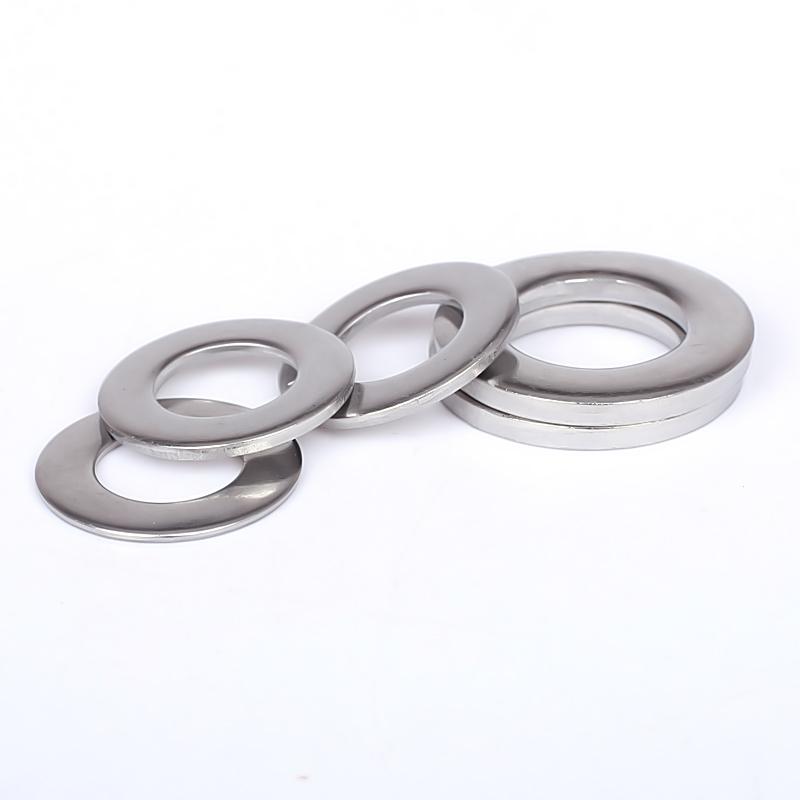
Outer diameter and thickness are just as critical as the hole size, yet these are rarely called out beyond a vague 'M6 washer' on a BOM. A thin, small-OD washer under a high clamp load will embed into soft aluminum or plastic, reducing preload over time. A thick, large-OD washer may overlap a nearby boss or interfere with a socket wall. Even among standards that sound similar—DIN 125, ISO 7089, and DIN 9021—the actual OD and thickness ranges are not identical, so swapping one part number for another can change how the clamp force spreads across the joint face.
Fit also depends on what the washer mates against, not just the bolt. If the clearance hole in the clamped part is drilled at 6.6 mm or higher, a standard M6 washer can shift off-center under vibration, no matter how well it fits the bolt shank. Some applications need a captive or self-centering washer, or a larger OD to bridge an oversized hole. Assuming an M6 washer will always fit ignores the tolerance stack between bolt, washer, hole, and coating thickness—and that stack is exactly where real assembly problems hide.
Corrosion Resistance in Practice: Coatings, Passivation, and Failure Points
Coatings rarely fail because the chemistry is wrong; they fail because the surface was never truly ready. Mill scale, residual oil, or even a light fingerprint can lift a primer within months. On welded joints, the heat-affected zone often gets less film thickness than flat plate, and sharp edges naturally pull coating away during curing. A practical approach is to specify stripe coats on corners and welds before the full system goes on, then verify dry film thickness at those same spots rather than averaging across a large panel. If the inspector only checks the easy flat areas, the first rust will show up exactly where nobody looked.
Passivation works only as long as the environment allows the oxide layer to rebuild. Stainless steel in a warm, chloride-heavy atmosphere may passivate initially, but crevices under gaskets or deposits can starve the surface of oxygen and turn passive film into active pitting. The same logic applies to aluminum: anodizing gives a thick, hard oxide, but a scratch through it exposes base metal that corrodes faster than untreated aluminum in some acidic conditions. The practical takeaway is to design out tight crevices and avoid using passivated parts in places where salt or moisture can sit undisturbed.
Most field failures concentrate at a handful of predictable points: threaded fasteners, lap joints, and transition areas between dissimilar metals. A stainless bolt in a carbon steel plate will eat the plate if the two are not electrically isolated, and the damage often hides under the bolt head. Coating holidays at sharp corners or cut edges let moisture wick under the film and spread laterally without visible surface rust until the blister pops. Regular inspection should target these high-risk zones with a bright light and a mirror rather than relying on overall appearance, because a structure can look sound from ten feet away while losing thickness inside a lap joint.
Supplier Questions That Reveal True OEM Capability
Most buyers ask about price and lead time, but those rarely expose whether a supplier actually controls the engineering behind the product. A sharper set of questions starts with tolerance stack-ups: how does the factory handle cumulative variation across mating parts, and does their team push back on unrealistic callouts before tooling starts? Their answer—or lack of one—shows whether you are talking to a true OEM or a trading company that will quietly outsource the hard decisions.
Another line of questioning digs into change management. If you alter a single material spec or surface finish mid-project, who owns the revalidation, and how is that documented? True OEM capability shows up in process ownership: traceable first-article reports, fixture revisions kept under configuration control, and a named engineer accountable for signing off on deviations. Suppliers that cannot describe this workflow usually do not have one.
Ask also about past failures. What product recall or field return forced them to rethink a design, and what concrete change came from it? A supplier with genuine capability will walk you through the failure analysis, the corrective action, and the updated DFMEA or process control plan. If they get vague or say it never happens, they are either hiding something or have not been tested at real OEM depth.
Cost Drivers That Have Nothing to Do with Raw Steel Price
Raw steel price often grabs headlines, but for many buyers the final invoice is shaped by factors that never show up in a commodity index. Energy-intensive processes like galvanizing or cold rolling can swing costs based on regional electricity and natural gas rates, which don't track ore or scrap markets. A plant running a pickling line or annealing furnace may see its cost per ton move with utility tariffs, not with the spot price of hot-rolled coil.
Warehousing and handling add another layer that has little to do with the mill's base price. Storing coils in climate-controlled yards, moving them with overhead cranes, and managing just-in-time delivery schedules all carry costs that accumulate quietly. In regions with tight industrial real estate, storage fees can jump even when steel prices are flat. For smaller fabricators, the cost of holding inventory—tying up working capital and paying insurance—often exceeds the raw material price swing.
Custom processing and compliance are easy to overlook but can dominate the final cost. Cutting to unusual lengths, punching holes, applying specialty coatings, or meeting traceability and testing requirements adds labor, machine time, and administrative overhead. A job that needs mill test reports, ultrasonic testing, or third-party inspection will carry premiums unrelated to the base steel price. Shops also face rising labor costs for skilled welders and machine operators, which can outpace any movement in the commodity market.
FAQ
In industrial purchasing, OEM means the washer is produced to the original equipment manufacturer's exact dimensional, material, and finish specifications rather than being a generic off-the-shelf part. This matters because even small deviations in thickness, hole size, or surface roughness can change clamp load distribution, lead to galvanic corrosion, or cause assembly failures in automated lines.
Aftermarket washers often meet only broad commercial tolerances, while OEM washers are tied to a specific print or standards callout. If you're maintaining certified equipment, using a non-OEM washer can void warranties, alter torque-tension relationships, or introduce a mixed-material lot that fails traceability audits.
304 (A2) and 316 (A4) dominate, with 316 preferred for chloride exposure, marine environments, or chemical processing. Some buyers overlook 410 for high hardness or 17-4 PH for strength, but the choice should follow the fastener material and the environmental pH/temperature range rather than defaulting to 304.
Don’t just say 'standard washer.' Reference ASME B18.22.1 for inch-series or ISO 7089 / DIN 125 for metric. Include inside diameter, outside diameter, and thickness tolerances. Many procurement errors come from ordering 'M10 washers' without noting whether you need narrow, regular, or wide series.
A bright, mirror-like finish isn’t just cosmetic; passivation after machining removes free iron and enhances the natural chromium oxide layer. Without proper passivation, even 316 washers can show tea staining or red rust in humid conditions, which industrial buyers often mistakenly blame on material grade.
Watch for mixed material certificates, vague mill test reports, and dimensional drift across batches. Some suppliers substitute 304 for 316 or skip final passivation. Insist on a documented first article inspection and random lot sampling rather than trusting a single certificate.
Customization is common—OD, ID, thickness, chamfer, edge deburring, and special markings can all be adjusted. However, custom tooling costs often make sense only above a few thousand pieces. For low volumes, a standard washer with secondary machining is usually more economical.
Ask for material certificates (EN 10204 3.1 or 3.2), dimensional inspection reports, a statement of passivation process, and if applicable, RoHS/REACH compliance. For critical assemblies, also request PPAP or a documented control plan. A supplier that hesitates to provide these is not ready for industrial OEM work.
Conclusion
Most industrial buyers learn quickly that a flat washer is never just a flat washer. The daily difference between 304 and 316 OEM-grade washers shows up less in a lab spec and more in whether a fastener assembly survives repeated washdowns or exposure to road salt. 316 earns its higher price when chlorides are present, but 304 often does the job indoors and in mild environments. Beyond alloy choice, the datasheet can hide what actually matters on the receiving dock. Two lots of M6 washers may share the same tolerance class yet feel completely different: one has sharp edges and uneven thickness, the other sits flat and loads evenly. Hardness numbers mean little if the washers cup under torque or crack near the ID. A buyer who only specifies "M6 washer" is leaving inner diameter, outer diameter, and thickness to chance, and that ambiguity can delay assembly or cause bolt loosening.
Corrosion resistance is equally practical. Passivation and coatings are not interchangeable; a poorly passivated 304 washer can rust faster than a clean 316 part, and crevices between washer and mating surface often become hidden failure points. When vetting suppliers, ask not just for certifications but for how they control batch traceability, deburring, and surface finish variation. Finally, raw steel price is a small slice of true cost. Tooling amortization, scrap rates from tight tolerance work, secondary finishing, and small-lot changeovers frequently drive OEM quotes more than nickel prices. Buyers who understand these levers can compare quotes on real capability rather than paper specs, and avoid sourcing surprises after the first shipment.
Contact Us
Contact Person: Shane
Email: [email protected]
Tel/WhatsApp: 8613357785029
Website: https://www.wanluohardware.com