

OEM Forklift Projector Benefits That Improve Warehouse Safety and Efficiency
2026-11-29
Warehouse floors rarely stay quiet for long—forklifts move fast, corners hide blind spots, and the margin for error is thin. Most safety measures sound good in a meeting but vanish once the shift gets busy. That’s where OEM forklift projectors come in. They turn a standard lift truck into a visible, predictable part of the workflow, marking pathways and stopping zones workers actually notice. At TNT, we’ve seen how the right projection setup doesn’t just reduce close calls—it tightens the entire operation. Here’s what that looks like on the floor.
How Forklift Projectors Make Warehouse Crossings Safer
Warehouse crossings often create blind spots where foot traffic and forklifts meet, and the result can be anything from a near miss to a serious collision. While mirrors and warning signs help, they rely heavily on people noticing them at the right moment. Forklift projectors change this by putting a bright, moving visual cue directly on the floor ahead of the vehicle. Instead of asking pedestrians to scan their surroundings, the projected pattern shows exactly where the forklift is heading and how much space it will occupy, which makes the crossing point feel less like a guessing game.
The real advantage comes from how the projection behaves in different lighting and floor conditions. Dusty concrete, polished epoxy, or poorly lit aisles can swallow traditional painted lines, but a strong LED projector cuts through that visual noise. Red or blue zone markers, chevrons, or even a simple line of light give workers a clear boundary that appears only when a forklift approaches. This temporary visual barrier is harder to ignore than a static sign, and since it disappears after the vehicle passes, it never turns into background clutter that people learn to tune out.
Facilities that add these projectors to busy intersections tend to notice a shift in how people move. Forklift operators report fewer sudden stops, and pedestrians begin to pause at the edge of the projected zone without being reminded. It is a low-friction safety upgrade that does not require retraining the whole workforce or redesigning the floor plan. By making the danger visible in the exact moment it matters, the crossing becomes a place where both sides share the same information instead of relying on luck and peripheral vision.
Why Floor-Level Light Cuts Through Noise Better Than Horns
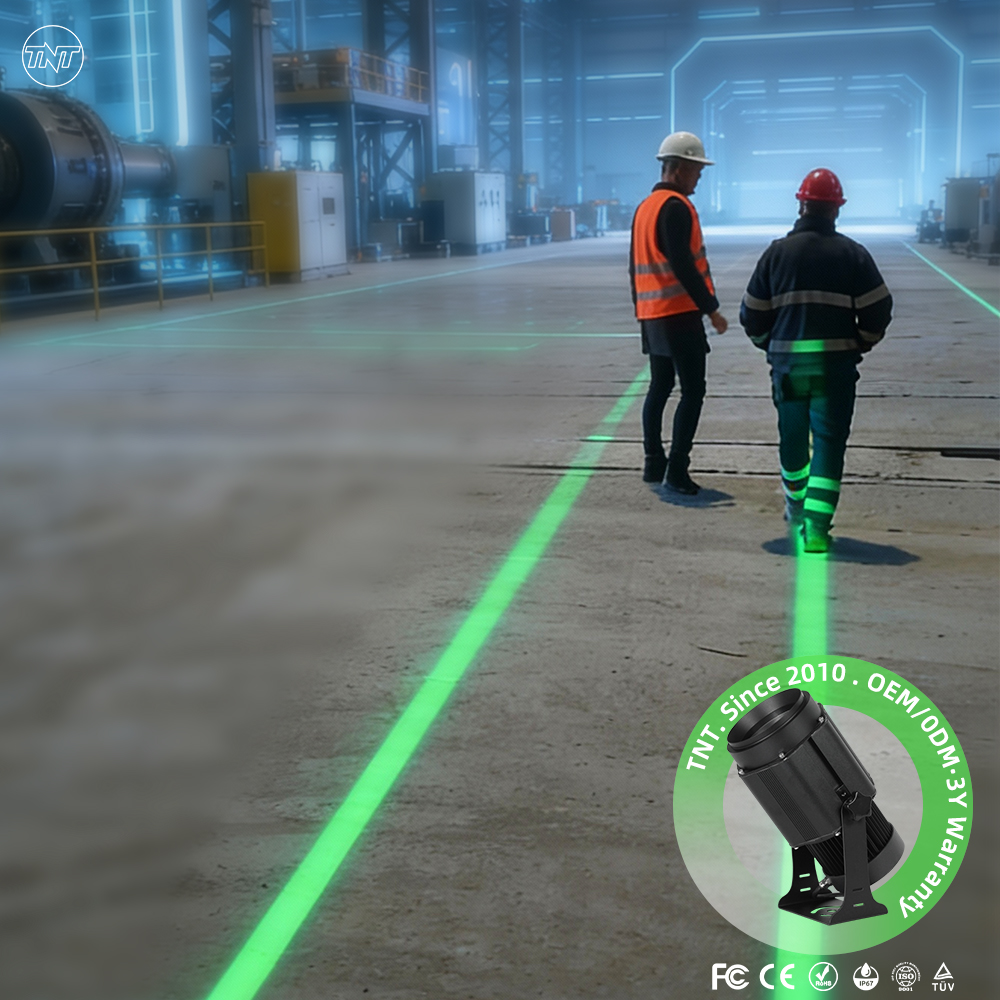
A horn pushes sound upward and outward, competing with every engine, shout, and echo bouncing off the walls. A low-mounted light, by contrast, doesn’t need to shout. It slides into the lower edge of a driver’s vision, where reflective vests, painted lane lines, and curb shadows already live. That placement makes it read as part of the road itself rather than another loud demand for attention.
The real advantage is signal clarity in a crowded field. Horns rely on volume to break through ambient noise, but at floor level there is far less visual competition. Most safety lighting sits at chest height or above; almost nothing meaningful happens near the ground. A steady pool of light down there feels unusual without being aggressive, so it draws the eye even in heavy traffic or bright daylight.
Drivers also process low light faster because it maps directly to movement and distance. A horn gives you no location data; a floor-level glow tells you exactly where the vehicle edge is and where it might move next. That kind of quiet, positional signal often cuts through mental noise better than any sound, especially in environments where people have learned to tune out alarms and honking.
Reducing Blind-Aisle Guesswork With a Visible Path
Rounding a corner straight into a wall of shelving is the moment every picker learns to dread. You slow down, glance both ways, and still someone with a cart full of returns nearly clips your ankle. That hesitation isn't just annoying—it's the hidden tax of every poorly marked intersection. When you can see where the next turn leads before you commit to it, the whole rhythm changes. Your stride stays unbroken because the decision was already made fifty feet back, not in the middle of a near-collision.
Warehouses that rely on overhead mirrors and reflective domes give you information too late to matter. A better approach is to paint the path itself into the floor: a wide, high-contrast lane that bends where the aisles bend, so your peripheral vision picks up the route without a second thought. Some facilities go a step further with angled stance markers at decision points, telling walkers whether the next stretch is foot traffic, equipment traffic, or mixed. The goal isn't more signage—it's fewer interruptions to your forward motion.
Once that visible path becomes part of daily movement, you start noticing how much energy used to go into scanning for hazards that weren't there. New hires pick up the flow in a day instead of a week, and the near-miss reports drop because people no longer pop out of blind aisles expecting luck to save them. It's not about turning a warehouse into an airport terminal. It's about making the obvious route actually obvious, so everyone can keep their eyes on the work instead of the traffic.
Factory-Installed Projectors That Avoid Retrofit Delays
Choosing a projector that arrives already built into the vehicle changes the timeline before work even starts. Instead of coordinating separate hardware, mounting kits, and wiring looms after delivery, the unit is positioned and powered during assembly. That eliminates the usual back-and-forth with service departments and lets vehicles head straight into daily routes without sitting idle for an aftermarket install.
The practical benefits show up in tight fleet schedules and multi-shift operations. Connectors are routed through factory channels rather than improvised paths, so there are fewer exposed wires and less risk of interference with other cab systems. Calibration is also completed in a controlled production environment, reducing the need for return visits and keeping the focus on the job instead of the workshop.
For procurement teams, this approach trims the hidden costs that often follow retrofits: extended downtime, warranty gaps between components, and inconsistent installation quality across different vehicles. A factory-installed projector offers one accountable source, a cleaner installation, and a much shorter gap between delivery and deployment.
Long-Lasting Aisle Warnings Without Paint or Tape Upkeep
Paint and tape both start losing the argument the moment a loaded pallet jack pivots on the same corner. Within weeks the bright line turns into a scuffed suggestion, and someone has to block the aisle, dry the floor, and babysit the area just to restore what should never have disappeared. The cycle eats more time than the initial application ever saved.
Durable pre-cut markers with beveled edges and a bonded underside skip that entire rhythm. They install in one pass, sit flush enough to survive scrubbers and steady traffic, and keep their contrast because the color runs through the material rather than sitting on top. Minor damage stays local—a single piece lifts and gets replaced while the rest of the aisle stays open.
For busy facilities, that changes the conversation from repaint schedules to a simple question: which areas still need clearer boundaries. The warning stays visible, maintenance hours go back to actual maintenance, and the aisle keeps its edge without becoming another recurring weekend project.
Keeping Pedestrians Alert at Docks and High-Traffic Intersections
Dock zones have a rhythm all their own—forklifts swinging wide, trucks backing toward loading bays, and pedestrians threading through the same narrow lanes as cargo. Most warning signs here fade into the background after a few days because they compete with stacked pallets and flashing terminal lights. The trick is not more signage but sharper contrasts: ground-level LED strips that trace the exact walking path, mirrors angled to reveal blind corners near barge ramps, and a short audio cue that changes tone when a vehicle shifts into reverse. Workers begin to read these cues the way they read weather—without stopping to think.
At busy intersections outside the gate, the challenge shifts. Pedestrians glance at phones, step off curbs a beat early, or fixate on the crosswalk signal while a turning bus clips the corner. Paint alone rarely holds attention. Intermittent pavement lights that pulse outward from the crossing—not blinking, but flowing in the direction of safe movement—tend to pull eyes down at the right moment. Pair that with raised crosswalks that force drivers to slow before the turn, and the intersection stops feeling like a test of nerve. Small design changes like these do more than an extra set of signs, because they work on instinct rather than instruction.
The common thread is predictability. Pedestrians move more alertly when a space tells them exactly where to look and when to step, without shouting. At docks, that might mean painting the safe walking corridor a single non-slip color that appears nowhere else in the yard, so the brain recognizes it as a path before it reads any words. At intersections, it might mean syncing the pedestrian countdown to a subtle underfoot vibration for those who can't keep eyes on the signal. None of this requires a campaign or a lecture—just a few deliberate choices that make the environment do the reminding.
FAQ
Painted lines wear down quickly under forklift traffic and fade in areas with dust or moisture. Projectors create crisp, high-visibility markings that stay consistent without constant repainting, and they can be relocated or updated as warehouse layouts change.
Workers get an immediate visual cue about where the lift truck will travel and how much clearance it needs. This reduces surprise encounters at blind corners and helps pedestrians keep a safe distance, cutting down near misses.
When operators can see true alignment guides for pallet insertion and aisle positioning, they make fewer contact errors with racks, beams, and stored goods. The result is less damaged inventory and fewer repair bills.
Many OEM units are built with high-lumen outputs and focused lenses, so the projected symbols remain visible even under overhead LED or natural light. Selecting the right color and brightness for the space makes a big difference.
Yes, OEM options often allow custom lenses or color choices so a receiving dock can show one pattern, a pedestrian walkway another, and a narrow aisle a different warning. That flexibility helps standardize visual communication.
OEM projectors are designed to match the specific mounting points, voltage, and vibration profile of the forklift model. That usually means easier installation, better durability, and support from the equipment manufacturer if something goes wrong.
Operators spend less time second-guessing approach angles or correcting misaligned pallets. Clear reference lines speed up load handling, reduce backtracking, and keep traffic flowing through busy areas more predictably.
Most need occasional lens cleaning and a check of the mounting hardware. Because they are solid-state lighting devices without moving parts, there is usually no routine bulb replacement, which keeps downtime low.
Conclusion
Warehouse crossings become easier to manage when a forklift projector places a bright, moving light path on the floor well ahead of the truck. Instead of counting on a horn that competes with conveyors, dock levelers, and radio chatter, the projector gives workers a visual boundary that appears before the forklift reaches the corner. That cue is especially useful in blind aisles, where racking blocks the view and operators often have to ease forward on instinct. A floor-level beam removes much of that guesswork by showing the intended travel line, so nearby pedestrians can read the direction and speed of the truck without hearing a sound.
Factory-installed projectors avoid the fitting delays and extra brackets that can slow down a retrofit, which means the equipment is ready to work as soon as it is unloaded. The projected warning also holds up longer than painted lines or floor tape, cutting down on repeated maintenance and keeping aisles visible in dim or dusty conditions. At docks and high-traffic intersections, the moving light tends to register faster than signs or mirrors because it enters a worker’s field of view at ground level. In practice, that leads to fewer sudden stops and smoother traffic flow, since both operators and pedestrians have a clearer sense of where the forklift is heading before it gets there.
Contact Us
Contact Person: TNT SALE
Email: [email protected]
Tel/WhatsApp: 8613544277910
Website: https://www.tntprojector.com/