

OEM Arc Fault Detection Devices: Essential Safety Components for Modern Electrical Systems
2026-09-30
Electrical fires often start silently, hidden behind walls where traditional breakers can't see them. Arc faults—dangerous electrical discharges caused by damaged wires or loose connections—are a leading cause of those fires. That's why OEM arc fault detection devices have become non-negotiable for modern electrical systems. But not all AFDDs are created equal, and choosing the right OEM partner can make or break your product line. ETEK brings a different approach to arc fault protection, combining precision engineering with flexible customization that keeps your designs ahead of code requirements and customer expectations. Here's what you should know before building your next generation of safer electrical infrastructure.
The Hidden Fire Risk That Standard Breakers Miss
Most people assume that a tripped breaker is the only line of defense between an electrical fault and a house fire. That assumption is comforting—but incomplete. Standard thermal-magnetic breakers are designed to respond to two things: sustained overloads and sudden short circuits. They do that job well. The problem is that a significant share of electrical fires begin with conditions that never push current high enough to trigger either mechanism.
One of those conditions is the series arc fault. A loose wire at a receptacle, a screw that has backed out inside a junction box, or a cord pinched behind furniture can produce a small, erratic arc. The arc may be hot enough to char surrounding material, yet the current flowing through it often stays within the normal operating range of the circuit. The breaker never sees a fault because, from its perspective, nothing unusual is happening—just a normal load on the wire.
A related blind spot is the high-resistance connection, sometimes called a glowing contact. Corrosion, improper splicing, or a worn outlet can create a point where electrical resistance is unusually high. Current still flows, but that point heats up like a tiny heating element. Over time it can degrade insulation and ignite framing. Again, the breaker remains silent because the current draw is not excessive—it's simply being converted to heat in the wrong place.
How OEM Designs Tighten Arc Fault Detection Accuracy
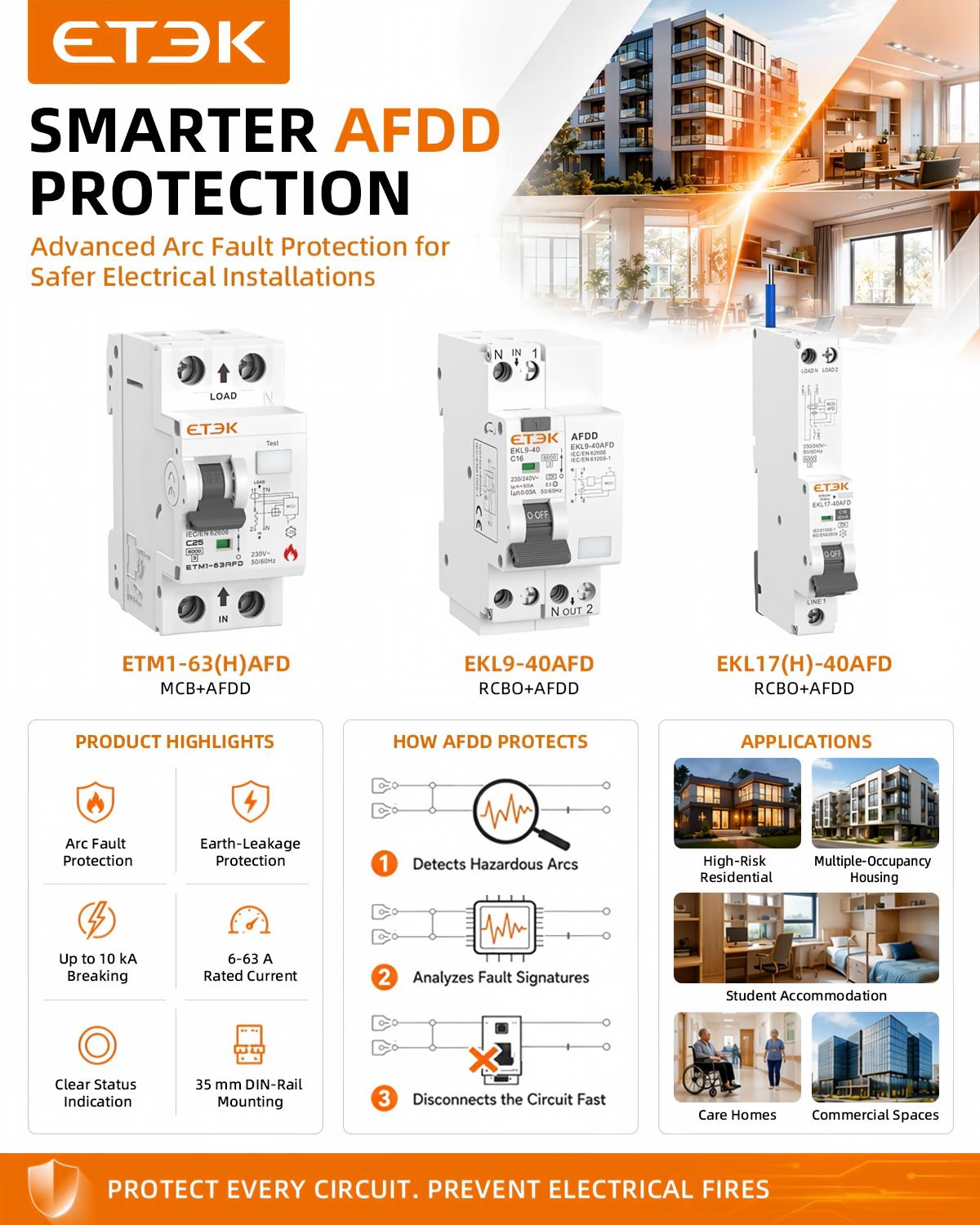
Arc fault detection has long struggled with nuisance tripping and missed events, but OEMs are now attacking the problem at the hardware level. Instead of relying on generic current transformers, many designs incorporate custom-wound Rogowski coils paired with high-resolution analog front ends. This combination captures the high-frequency signatures of arcing without saturating under normal load inrush, giving the detection algorithm a cleaner signal to work with.
The real leap comes from how OEMs tune their signal processing chains. Rather than applying a one-size-fits-all threshold, they characterize each panel's expected load profile during development. By feeding real-world arc waveforms—both series and parallel faults—into the detection firmware, they can adjust band-pass filtering and wavelet decomposition to isolate the chaotic, non-periodic bursts that distinguish arcs from motor brush noise or dimmer harmonics.
Calibration also plays an underappreciated role. Some manufacturers now embed self-test routines that inject a known arc signature at power-up, allowing the unit to compensate for component drift and temperature changes. This dynamic baseline adjustment means the detector stays accurate over years of service, rather than slowly degrading into either hypersensitivity or deafness to real faults.
Reading the Signals: Distinguishing Harmless Arcs from Hazardous Ones
A flicker at a switch or a brief snap when plugging in a device can be startling, but not every arc signals trouble. In everyday electrical systems, small arcs are a normal byproduct of current making or breaking contact. The key lies in the character of the arc: a harmless one tends to be brief, localized, and quiet—often a bluish spark at the exact point of connection with no lingering odor or heat. It appears the instant you operate the control and vanishes just as quickly, leaving no scorch marks or melting. If the device continues to run smoothly and the arc doesn't repeat on its own, it's usually part of normal operation.
Hazardous arcs, by contrast, announce themselves with persistence and intensity. A dangerous arc may buzz, crackle, or hiss continuously, even when nothing is being switched. You might notice a burnt smell, flickering lights, or discoloration around outlets and terminals. Unlike the clean snap of a healthy contact, a hazardous arc often has a ragged, sputtering quality and can throw visible sparks or glowing particles. These are signs of loose connections, damaged insulation, or overloaded conductors—conditions that generate heat and can escalate into fire or equipment failure.
Reading the signals also means considering context. An arc inside a sealed relay or a properly rated breaker is engineered to be contained; an arc at a worn power cord or a corroded terminal is not. Listen for changes over time: if a once-silent outlet starts crackling when you plug something in, that's a shift worth investigating. Similarly, if a motor's commutator sparking becomes brighter or more erratic, it may indicate worn brushes or a developing fault. Distinguishing between the two isn't about memorizing rules, but about noticing patterns—duration, sound, smell, and visual residue—and trusting that a repeat offender is rarely harmless.
From Residential Panels to Industrial Switchgear: Where AFDDs Earn Their Place
In a typical home distribution board, the AFDD sits alongside miniature circuit breakers and residual current devices, but it catches a different class of fault. Loose screw terminals, crushed cables behind drywall, or aging insulation can all generate low-current arc signatures that never reach the trip threshold of a standard breaker. That is exactly the niche AFDDs fill in bedrooms, living areas, and socket outlets, where smoldering fires often start long before a short circuit occurs. Their value here is fairly clear-cut: they watch for the erratic, high-frequency current noise of an arc and disconnect before heat builds into ignition.
Move into commercial and light industrial buildings, and the picture gets more selective. Motor drives, fluorescent ballasts, and switching power supplies all produce harmonic-rich waveforms that can mimic arc signatures, so placing an AFDD directly upstream of a variable frequency drive is often a recipe for nuisance tripping. Instead, engineers tend to reserve AFDDs for office socket circuits, server rack feeds, or lighting panels where the load profile is closer to residential use. In these spaces the device earns its keep by protecting older wiring or densely packed cable trays that are difficult to inspect regularly, while staying out of circuits where normal operation already looks a bit like an arc.
By the time you reach industrial switchgear and main distribution boards, AFDDs rarely take on the role of primary feeder protection. The available fault currents, impedance characteristics, and load noise in a large plant simply overwhelm the detection window that a residential arc fault device is designed for. That does not mean they vanish entirely, though. Auxiliary power supplies, control transformers, UPS inputs, and workshop socket outlets often remain suitable points where AFDDs can act as a second layer of defense. The practical approach is not to sprinkle them everywhere, but to identify the few circuits where their sensitivity is an asset rather than a maintenance headache.
Key Specifications That Separate Robust Devices from Checkbox Solutions
Many devices claim to be rugged, but only a handful withstand the daily abuse of industrial environments. True differentiation comes from specifications that go beyond superficial IP ratings. For example, wide operating temperature ranges from -20°C to 60°C, combined with vibration and shock resistance per MIL-STD-810H, separate a genuinely robust unit from one that merely survives a drop test in a controlled lab. Look for details like sealed connectors, high-brightness displays readable in direct sunlight, and fanless thermal designs that eliminate dust ingress points.
Another often overlooked spec is the durability of internal components under sustained load. A checkbox solution may list an IP65 rating but fail after repeated thermal cycling or exposure to humidity and salt fog. Robust devices specify continuous operation at full load across the entire temperature envelope, backed by documented mean time between failures (MTBF) values. Moreover, the power supply design matters—wide-input voltage ranges and transient protection ensure stable operation in sites with unstable power, something generic devices cannot guarantee.
Finally, connectivity and lifecycle support are key specifications that separate serious hardware from token offerings. Industrial protocols like Modbus, CAN bus, or PROFINET, along with long-term component availability and five-year product lifecycles, signal a design meant for deployment, not a one-off proof of concept. These details, often buried in datasheets, reveal whether a manufacturer engineered for real-world conditions or simply checked a box.
What Next-Generation Arc Fault Protection Looks Like in Connected Systems
Arc fault protection has moved well beyond the basic circuit breaker that simply trips when current gets too high. In today's connected electrical systems, the next generation of protection is built around continuous monitoring and contextual awareness. Sensors embedded in switchgear and panelboards stream real-time data on current signatures, temperature, and even acoustic emissions. This lets the system distinguish between a harmless arc from a motor brush and a dangerous parallel arc that can ignite surrounding materials. Instead of waiting for a threshold to be crossed, the protection logic learns the normal operating profile of each circuit and flags anomalies that deviate in subtle ways—often long before a full-blown fault develops.
Connectivity also changes how these systems respond. A next-generation arc fault device doesn't just trip locally; it communicates the event's location, duration, and severity to a central controller or cloud platform. Maintenance teams get a clear picture of which feeder, branch circuit, or even specific connection point is degrading. Some systems can transiently isolate a suspect zone while rerouting power through alternate paths, keeping critical loads online. This is especially valuable in facilities with high arc flash risk, such as data centers or industrial plants, where a single unplanned outage cascades quickly. The protection becomes proactive rather than reactive.
The real shift, however, is in integration. Next-generation arc fault protection shares data with power quality monitors, thermal imaging sensors, and energy management software. When a loose lug starts to heat up, the system correlates that with rising high-frequency noise from micro-arcing. It can then schedule a targeted shutdown during a low-demand window instead of forcing an immediate trip. For installers and facility managers, this means fewer nuisance trips, faster root-cause analysis, and the ability to document arc fault risks before an inspector or insurance auditor asks. The technology is no longer just a safety net—it's a diagnostic and planning tool that lives inside the broader connected infrastructure.
FAQ
An arc fault happens when electricity jumps across a gap or through damaged insulation, creating intense localized heat that can ignite surrounding materials. Unlike a short circuit or overload, the current is often too low or too irregular for a standard breaker to trip. Dedicated arc fault detection devices monitor the waveform for these erratic signatures and interrupt power before things get hot enough to start a fire.
OEM units are built to integrate directly into a manufacturer's panel, appliance, or power distribution design, so they can be tuned to the specific load profile, communication protocol, and enclosure constraints of that product. Off-the-shelf breakers are more general-purpose. The OEM route gives you tighter control over trip thresholds, nuisance tripping behavior, and form factor, which matters a lot in industrial drives, EV charging, or renewable energy gear.
While residential codes have driven a lot of the awareness, arc fault detection is just as critical in commercial and industrial settings. Data centers, solar inverters, motor control centers, and battery storage systems all have high-energy environments where a loose connection or damaged cable can arc without tripping a standard breaker. OEM versions are often ruggedized and configured for higher voltages, DC circuits, or specific fault patterns in those applications.
Nuisance tripping often comes from loads that naturally produce arc-like signatures, such as brushed motors, switching power supplies, or certain LED drivers. In an OEM design, you can reduce this by using more sophisticated signal processing, learning the normal current pattern of the connected equipment, or coordinating detection thresholds with the specific appliance's startup behavior. That's a big advantage over generic devices, which have to be conservative enough for unknown loads.
It depends on the market and application. In North America, UL 1699 covers arc fault circuit interrupters, while for equipment-level integration you might also look at UL 60730 or IEC 62606, which is widely used for arc fault detection devices in final circuits. Automotive and aerospace have their own stringent requirements. A serious OEM partner will be able to document compliance for the specific region and end-use, not just claim general arc fault protection.
Yes, but DC arc faults are trickier because there is no zero-crossing point to naturally extinguish the arc. Detection algorithms have to rely on high-frequency noise, current step changes, or other signatures, and the interrupting mechanism must handle sustained DC arcing. OEM devices for solar combiners and battery storage systems are specially designed for these challenges, often integrating with the system's main contactor or solid-state switching.
Look at the partner's experience with your specific voltage and current range, their ability to customize trip curves and communication interfaces, the reliability of their supply chain, and how they handle firmware updates if the detection algorithm evolves. Also ask for field failure data because nuisance trips or missed arcs can damage your brand far more than the per-unit price. A good partner will work with you on validation testing under realistic load conditions.
Conclusion
Standard circuit breakers trip on overcurrent and short circuits. They do nothing about the low-level, high-temperature arcs that start inside worn insulation, loose terminals, or damaged cords. OEM arc fault detection devices close that blind spot. They sample current waveforms at high speed and look for the messy, random signatures of real arcing—not just any quick spike. The hard part is telling a dangerous arc apart from the harmless ones produced by a drill's brushes or a wall switch. OEM designs handle this through pattern libraries built from thousands of load profiles, then tune the detection window to avoid false trips. That balance matters: a device that cries wolf gets removed, and one that is too timid lets a fire smolder unnoticed.
AFDDs are no longer limited to bedrooms or living spaces. They are showing up in commercial kitchens, server rooms, and industrial control cabinets, where a single undetected arc can destroy equipment or stop a production line. Robust models earn their place by surviving voltage sags, motor inrush, and noisy variable-frequency drives without nuisance trips. Spec sheets should go beyond basic compliance—check response time, rated current, and the test conditions used to verify performance. The newest generation adds communication capability, logging arc events and even recording pre-fault waveform snippets. That data feeds into building management systems, giving maintenance crews a heads-up before a glowing connection becomes a fire. In connected facilities, this shifts arc fault protection from a simple safety device to an early warning node.
Contact Us
Contact Person: Andy
Email: [email protected]
Tel/WhatsApp: +86 13356133008
Website: https://www.etek-china.com/