
M8 Connector Company Guide for Reliable Industrial Connectivity
2026-11-29
Industrial networks rarely fail in dramatic ways—they fail at the smallest connection points. M8 connectors may look like basic hardware, but they carry power and signal through tight spaces, constant vibration, and harsh washdowns where larger interfaces become liabilities. This guide cuts through supplier noise to show what reliable M8 connectivity actually requires, and why REUNION keeps appearing on shortlists when engineers stop guessing and start comparing.
How M8 Connectors Keep Tight Spaces From Turning Into Tight Deadlines
Anyone who has tried to wire a sensor block inside a crowded machine frame knows that space is rarely a design luxury. M8 connectors solve this by giving you a lockable, circular interface that barely extends beyond the cable itself. Instead of wrestling with terminal strips or bulky cable glands, technicians can route prewired cables through narrow channels and snap them into position without needing extra clearance for a screwdriver. The compact footprint means more I/O points can sit closer together without turning the enclosure into a puzzle.
The real advantage in deadline-driven work is how quickly an M8 connection goes from loose parts to a finished circuit. Many cables arrive overmolded and color-coded, so there is no stripping, crimping, or guessing which conductor feeds which pin. That removes a whole class of wiring mistakes that usually only appear during commissioning, when every correction costs time the schedule does not have. A firm threaded coupling also gives you tactile confirmation that the connection is seated, which keeps installers from second-guessing their own work in areas they cannot easily see.
When something does fail or a sensor gets damaged, a compact connector changes the repair timeline. You can unthread the old unit, replace it, and reseat the cable without moving neighboring hardware or unwrapping harnesses. That kind of serviceability matters most in tight spaces where one difficult swap can cascade into a longer shutdown. With M8 connectors, the physical constraints remain, but they stop dictating how long the job has to take.
Decoding Pin Layouts and Keying Before the Wrong Plug Reaches the Line
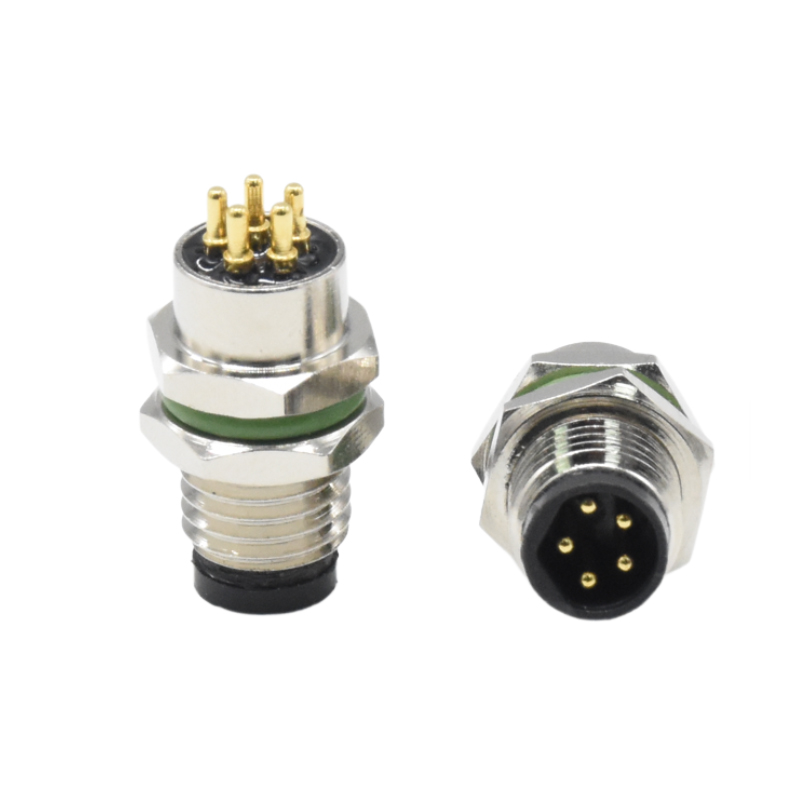
Most connection mistakes on a build floor don't happen because someone ignores a spec sheet. They happen in a hurry, with two similar shells sitting next to each other and only a second to grab one. Pin layout becomes the first thing worth reading: the number of positions, the blanked cavities, the slight offset of a row, or a ground pin that sits just outside the expected grid. A quick look at the face of the connector often tells you more than the part number stamped on the housing, especially when that stamp has worn smooth.
Keying does the work that attention sometimes won't. A molded rib, an offset groove, or a differently shaped latch can turn a wrong orientation into a firm mechanical refusal. The useful part is that keying doesn't rely on color codes or labels, things that fade or get ignored. When the shell geometry is designed so that the mating faces can only close in one orientation, the operator gets immediate feedback. Some equipment even uses stepped keyways or secondary tabs to separate connectors that share the same pin count but carry different signals, which prevents the sort of damage that a pinout chart alone can't stop.
Before seating a plug, it's worth reading the small cues that aren't always called out in bold: the location of pin 1, the shape of the shroud, a missing contact position, or a chamfer that matches only one side of the header. Counting pins is useful, but it isn't enough when several harnesses use identical shells. A deliberate glance at the keying features and the pin map before the plug reaches the line keeps a simple mechanical step from becoming a board-level fault.
The Difference Between a Sealed Connector and One That Only Looks Sealed
A connector can wear all the right armor—rubber grommets, a thick housing, maybe even an O-ring peeking out at the seam—and still let moisture creep in where it hurts. The real difference isn't always visible from the outside. A genuinely sealed connector is designed so that every potential entry point, from the wire exit to the mating face, is backed by a compression seal or an adhesive potting that stays effective under pressure, temperature swings, and vibration. One that only looks sealed often relies on a snug fit or a decorative boot, which works fine on a sunny workbench but fails the first time the assembly sits in a damp engine bay overnight.
Look closely at how the wires enter the back of the connector. On a true sealed unit, each wire passes through a soft silicone or rubber gland that squeezes around the insulation, not just around the bundle. The cheap imitation might have a rubber cap that looks identical in a product photo, but it's often rigid plastic or a loose-fitting sleeve with no actual compression. Over time, capillary action pulls water along the wire strands, past the fake seal, and into the terminal cavity. The corrosion that follows usually stays hidden until a sensor starts reading erratically or a light flickers in the rain.
Another tell is what happens when the connector is unplugged and reconnected a few dozen times. A proper environmental seal has a wiping action—the interfacial seal on the pin side presses against the socket side, clearing away dust and moisture with each mating cycle. A cosmetic seal just sits there, maybe cracked already from UV exposure. If the datasheet only says "weather-resistant" without naming a specific IP rating or test standard, that's often a clue the manufacturer is describing a shape, not a guarantee. Field experience tends to sort them out fast: the sealed one keeps working, while the lookalike leaves you chasing ghost faults after every heavy dew.
Questions Worth Asking Before You Commit to an M8 Supplier
Before you sign anything, ask whether the supplier actually understands your product beyond the drawing. A good M8 partner will question tolerances, surface finish, or material choices instead of just quoting the lowest price. If the conversation never goes deeper than mold steel and cycle time, you might be dealing with a vendor, not a partner.
Look closely at how they handle change requests. Prototypes rarely stay frozen, and an M8 supplier should be able to absorb small shifts without punishing you with re-quoting delays or surprise fees. Ask for a concrete example of a recent project where the design moved mid-stream and how they kept the timeline intact.
Finally, dig into their failure record — not the shiny case studies, but the jobs that went sideways. A supplier who can walk you through a past tooling mistake, the root cause, and the correction process is worth more than one who claims a perfect history. That honesty usually predicts how they will treat your project when something inevitably goes wrong.
Custom Overmolding Without Multiplying Lead Times
Custom overmolding usually gets blamed for pushing schedules out, but the delay rarely comes from the molding step itself. The slowdown happens when part geometry, substrate material, and TPE bond strength are treated as separate decisions. When those variables get locked early through a short material compatibility review and a focused DFM pass, custom doesn’t have to mean late.
A practical way to keep timelines intact is to run substrate and overmold development in parallel rather than waiting for one side to freeze. Modular mold inserts, pre-qualified material pairings, and clear gate and vent placement from the first tooling review remove the usual back-and-forth. That approach lets design teams change durometer, surface finish, or color without restarting the tooling conversation.
The real difference shows up in project rhythm. Instead of adding weeks for each custom feature, the schedule holds because the supplier is already working from a defined envelope: acceptable shrinkage, bond area, wall thickness, and texture limits. Custom overmolding then becomes a way to differentiate the product, not a reason to extend the launch date.
Keeping Vibration and Washdowns From Quietly Breaking Your Connection
Most connectors fail slowly, not from a single overload but from the constant tiny movements that vibration creates at the contact interface. Fretting wear scrapes away the plating and leaves behind oxidized debris, so resistance creeps upward and signals start dropping out at random moments. Washdowns add a second front: every jet of water finds the smallest seam, and once moisture or cleaning agent gets inside, corrosion starts where you cannot see it.
The frustrating part is that the outside of the housing often looks fine while the connection is quietly degrading. Threaded collars lose preload, O-rings harden or shrink after repeated temperature swings and chemical exposure, and cable glands that were never tightened to the right torque begin to act like a slow leak. By the time an intermittent fault becomes bad enough to shut down a line, the connector internals may already be pitted, discolored, or coated with residue.
Preventing this takes more than picking a component with a high IP rating. Look for connectors with locking features that resist rotation, use backshells or potting where vibration is severe, and anchor cables so movement stops before it reaches the contact point. During installation, keep seal surfaces clean, torque connectors to the manufacturer's value, and replace hardened gaskets on a schedule instead of waiting for visible damage. Small changes at the connection point usually cost far less than chasing an intermittent failure across a machine.
FAQ
Start with the sealing rating. IP67 is a minimum, but washdown or temporary submersion calls for IP68 or IP69K. Check that the coupling nut has a locking mechanism that resists vibration and that the housing material can handle corrosion. Overmolded cable entries are usually better than mechanical clamps because they remove a common leak point.
If cable routing is uncertain or installers need to cut to length on site, field-wireable versions are practical, but they depend heavily on careful assembly. Overmolded assemblies give more repeatable sealing, faster installation, and better performance under vibration, especially when you can specify the exact cable length and connector orientation in advance.
For standard 100 Mbit industrial Ethernet, PROFINET, or EtherNet/IP over M8, a 4-pin D-coded connector is the typical choice. A-coded is more common for sensors, DC power, and IO-Link, while B-coded is used for some fieldbus systems. Matching the coding to the protocol avoids mis-mating and signal issues.
It depends on the pin count, coding, and current draw. A 4-pin A-coded M8 can often carry 24V power along with a sensor signal or IO-Link communication for low-current devices. If the load is higher or you need a separate ground path, a dedicated power connector or additional pins make the design safer.
At minimum, look for CE marking, RoHS and REACH compliance, and a recognized safety certification such as UL listing when the equipment ships to North America. For M8 circular connectors, compliance with IEC 61076-2-104 is a good reference point. Ask for the relevant certificates instead of relying on a general statement.
Use a flex-rated cable with the correct bend radius and keep the first bend as far from the connector as possible. An overmolded strain relief helps absorb movement, and the cable should be clamped or supported so the connector itself is not constantly flexing. Testing a sample under repeated bending is worth the time.
For standard M8 connectors with common cable types, a supplier may ship stock or short-run orders in one to three weeks. If the design includes special cable, custom overmold colors, labeling, or unique lengths, expect closer to four to six weeks. Tooling for a new connector body will add more time, so asking before the design freeze is smart.
The price usually reflects the contact material and plating, housing material, overmold compound, and the amount of testing behind the part. Gold plating thickness, stainless steel parts, UL certification, and batch traceability all add cost. Cheaper versions may look similar but often cut corners on sealing, plating, or dimensional consistency.
Conclusion
Space on a modern production line is rarely a luxury, and M8 connectors earn their place by fitting into control cabinets, sensor housings, and robotic end-effectors where larger formats simply cannot go. But a small footprint means little if the wrong pin arrangement or keying orientation reaches the panel. Reading a layout diagram before ordering prevents the exact mistake that turns a quick install into a late shift, and pairing that check with a clear understanding of whether the connector is genuinely sealed—not just molded to look sealed—keeps moisture and coolant from finding an entry point under pressure.
Supplier choice quietly shapes how long that reliability lasts. It is worth asking how a company handles custom overmolding, because the ones that treat it as a normal request rather than a special project tend to keep lead times from stretching. The harder test comes later, on equipment that vibrates through every cycle or gets hit with washdown sprays. A solid M8 build keeps contact points stable and the housing sealed long after the initial install, so the connection does not become the weak link that maintenance has to chase.
Contact Us
Contact Person: Hayley Liang
Email: [email protected]
Tel/WhatsApp: +86 13480625451
Website: https://www.reunion-china.com/