

High Titanium White Masterbatch Ranking Top Performers for Brilliant White Plastics
2026-08-28
Achieving brilliant white in plastics is rarely as simple as adding more TiO2. The real difference lies in the quality and dispersion of your high titanium white masterbatch. With suppliers flooding the market, we ranked the formulations that truly stand out for opacity, cleanliness, and processing stability — and one name keeps surfacing among the top performers: Xinwancai. Here’s what the leaders do differently.
Why Your White Plastic Still Looks Gray Even With High TiO2 Loadings
Most people assume that adding more TiO2 automatically makes plastic whiter. But if you've ever pushed loadings past 15 or 20 percent and still seen a dull gray cast, the problem isn't the amount of pigment—it's what the pigment is doing once it's inside the polymer. The first thing to check is dispersion. TiO2 particles are tiny, around 200-300 nanometers, and they have a strong tendency to clump. Once agglomerates form, they stop scattering visible light the way individual particles do. Instead of reflecting white light back to your eye, they create larger, irregular surfaces that scatter light unevenly and can even absorb some wavelengths, giving the plastic a muddy or gray appearance.
Another overlooked cause is the photocatalytic activity of TiO2 itself. Even rutile grades, which are more stable than anatase, can generate free radicals when exposed to UV light, especially if the surface treatment is poor or damaged during compounding. Those radicals attack the polymer matrix, causing yellowing or browning that mixes with the white pigment to look gray. High loadings don't fix this—they can make it worse, because more TiO2 means more surface area for radical generation, and the extra pigment can act as a pro-degradant if it's not properly coated.
Finally, there's the issue of refractive index and particle spacing. TiO2 works by bending light more than the surrounding polymer. But at very high loadings, particles get too close to each other. When the distance between them drops below roughly half the wavelength of visible light, the scattering efficiency collapses—a phenomenon known as crowding. The plastic can actually appear less white than a lower-loading formulation, because the tightly packed particles no longer scatter as independent centers. You end up paying for more TiO2 while getting a grayer part. The fix is rarely to keep adding pigment; it's to improve dispersion, choose the right surface-treated grade, and sometimes reduce the loading to let each particle do its job.
The Real Reason Some White Masterbatches Arrive Inconsistent
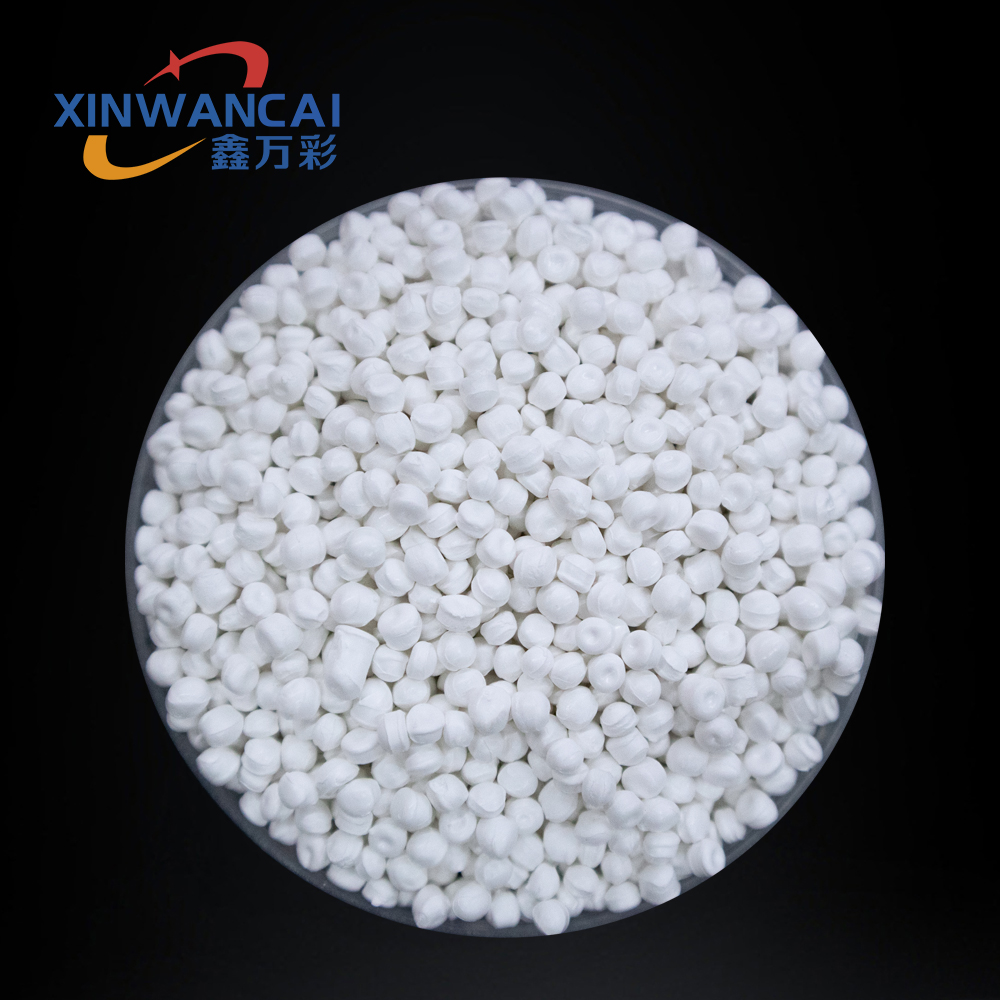
A white masterbatch is rarely just titanium dioxide and wax. It’s a tightly packed mix of carrier resin, dispersants, and pigment that can separate during high-speed compounding if the screw profile or temperature profile drifts by even a few degrees. When the line runs hot, low-molecular-weight additives will phase out and drag TiO2 with them; when it runs cool, the pigment never fully wets out. Those half-melted clusters stay intact through pelletizing and show up later as specks or streaks in film, sheet, or injection molded parts.
The second culprit is raw material drift. A “same grade” TiO2 from two different reactors or two different suppliers can carry different surface treatments, and those coatings change how the pigment pulls into the polymer. If the carrier resin lot has a slightly higher melt flow, or the wax package is reformulated without a flag on the datasheet, the masterbatch can leave the plant within spec but still print differently at the customer’s feeder. By the time it reaches the extruder, the inconsistency looks like a formulation error — but it often started upstream, in the tiny differences nobody thought to measure.
Yellowing at the Die Isn't Always a Resin Problem
When a yellow ring or haze shows up around the die in an LED package, the first suspect is usually the encapsulant or molding compound. But in plenty of failure analysis cases, the resin tests clean. Instead, the discoloration traces back to leftover flux from the die attach process, a silver-filled epoxy that started to break down under high current density, or even a reflector coating that degraded and migrated toward the chip. Swapping out the resin doesn’t fix these issues, and the yellowing comes right back after a few hundred hours.
The location and shape of the yellowing often give the real clue. If the stain hugs the die edge or appears underneath the chip, it’s rarely the bulk resin. Underfill materials, die attach pastes, and flux residues can all oxidize and turn amber when exposed to repeated thermal cycling or blue light. In some cases, moisture trapped at the die-substrate interface reacts with the backside metallization, producing a thin yellow film that looks like resin degradation from the outside. A quick FTIR or SEM/EDS spot check on the discolored area will usually reveal elements like tin, silver, or sulfur that don’t belong to the resin system.
Before you spend weeks qualifying a new resin, check the assembly materials and reflow profile. Run a cleanliness test on the substrate after die bonding, and look at the die attach fillet under UV light. Many “resin yellowing” complaints turn out to be a process residue issue or a mismatched material pair. Fix the source, and the yellowing disappears without touching the encapsulant.
How Carrier Resin Choice Changes Whiteness in Polypropylene and Polyethylene
Carrier resin choice quietly dictates how white a polypropylene or polyethylene compound appears, even when the same pigment and loading are used. The base polymer’s melt viscosity during compounding determines how thoroughly titanium dioxide or other whiteners get wetted and deagglomerated. A low-viscosity carrier flows around pigment clusters more easily, breaking them into finer particles that scatter light more efficiently. With a higher-viscosity carrier, the same shear force leaves more aggregates intact, and those larger particles reflect less light across the visible spectrum, making the final part look duller or more gray.
Differences between polypropylene and polyethylene carriers amplify this effect because their crystallization behavior influences how pigment particles sit in the solid state. Polypropylene typically cools into larger spherulites than polyethylene, and these crystalline regions exclude pigment particles, pushing them into amorphous boundaries. If the carrier resin has a narrow molecular weight distribution, those boundaries become more defined, creating localized pigment crowding that reduces whiteness. Polyethylene, especially linear low density grades, tends to form smaller crystallites and a more uniform pigment distribution, so the same pigment concentration often yields a slightly higher L* value than in polypropylene.
Practical adjustments come down to matching carrier resin melt flow and comonomer content to the compounding process. A carrier with a melt flow rate 10–15 g/10 min higher than the base resin can improve pigment dispersion without sacrificing mechanical properties, provided the carrier’s density remains close to the matrix. In polyethylene, using a carrier with a small amount of hexene or octene comonomer shifts the crystallization pattern enough to reduce pigment exclusion zones, giving a measurable boost in whiteness. These choices are rarely obvious from datasheets alone, but small pilot runs with matched carrier and matrix resins show how much whiteness depends on the hidden carrier behavior.
Spending More on Titanium Dioxide Doesn't Guarantee a Brighter Part
Many processors assume that bumping up the titanium dioxide percentage will keep making the molded part whiter and brighter. Past a certain loading, the extra pigment actually starts working against you. TiO2 particles crowd together, scattering light less efficiently and sometimes creating agglomerates that show up as specks or dull patches. You end up paying more for raw material while the visual gain flattens out or even reverses.
The base resin and processing conditions usually matter more than the last few percent of pigment. A slightly yellow polymer, excessive barrel heat, or high shear can introduce thermal degradation products that mute brightness no matter how much TiO2 you add. Surface gloss also plays a role—if the part comes out with micro-roughness or flow marks, light reflects poorly and the eye reads it as less bright.
A better approach is to run a quick ladder study on your own line. Start with a modest TiO2 level, then increase in small steps while measuring color and gloss after each change. You'll often find a clear plateau where additional pigment buys almost nothing. Swapping in a better dispersant or lowering melt temperature can deliver a brighter part at lower cost than simply dumping in more titanium dioxide.
What It Takes to Run White Masterbatch in Thin-Wall Molding Without Streaking
Streaks in thin-wall white parts rarely come from the masterbatch alone. They trace back to how the pigment agglomerates break down under low residence time and high shear. A TiO2-heavy white concentrate needs a carrier resin with a melt flow index close to the base polymer, otherwise the colorant lags behind and forms visible flow lines near the gate. We start by matching viscosity, not just LDR, then drop the screw speed 10–15% while raising back pressure just enough to keep dispersion active without overheating the melt.
Tooling geometry matters more than most processors admit. Thin-wall parts often run with fast injection and short hold times, which can tear open the colorant layer and leave a silvery streak along the weld line. The real fix is to position the gate for laminar flow and use a slightly wider land length on the runner. A small taper in the sprue bushing also helps the white concentrate blend before the melt hits the cavity. If the streak follows a knit line, pre-dry the masterbatch and the base resin to the same moisture level—differential drying creates steam that drives pigment separation.
Finally, don't chase the white by adding more masterbatch. That usually makes streaks worse because you push the dispersion limit. Stick to a concentrate with a higher pigment loading but a well-designed wetting agent, and consider a two-stage screw if your machine allows it. The goal is to reach full color development in the metering zone, not in the part. A simple check: take a purge sample at steady state and press it flat. If you see tiny specks or a marbled surface, you haven't broken the agglomerates yet—adjust the temperature profile or switch to a finer particle size TiO2 before blaming the masterbatch.
FAQ
It describes a concentrated white pigment formulation where titanium dioxide makes up a notably high share—often 50% to 80% by weight—dispersed in a polymer carrier. This allows processors to achieve strong hiding power and clean white tones without loading excessive masterbatch into the base resin.
The key checks are titanium dioxide content, dispersion quality, melt flow compatibility, opacity or hiding power, whiteness value, and thermal stability during extrusion or molding. A top performer keeps these balanced rather than just chasing the highest TiO2 percentage.
Poorly dispersed titanium dioxide forms agglomerates that reduce opacity, create surface defects, and force higher dosage to hit target whiteness. A masterbatch with excellent dispersion can use less material while delivering brighter, more uniform color and smoother processing.
They typically offer lower addition rates—sometimes 2% to 5% by weight depending on resin and target opacity—along with stable viscosity and minimal screw slippage. This shortens color changeovers and reduces rejects caused by streaks, specks, or uneven whiteness.
Yes. Film and sheet applications often need high opacity at very low thickness, while injection molding demands good flow and surface gloss. Wire and cable or pipe extrusion may prioritize thermal stability and weatherability. Top performers usually publish separate grades tuned to these processing windows.
The carrier should be compatible with the host polymer—typically polyethylene, polypropylene, or a universal system. A mismatched carrier can cause delamination, poor dispersion, or reduced mechanical properties. Leading products clearly state carrier type and recommended dilution ratios for each resin family.
They pair high-quality rutile TiO2 with optimized wax and additive packages that preserve surface smoothness and impact strength. Some grades include optical brighteners or blue toners to lift perceived whiteness, but the best ones avoid overloading additives that could migrate or affect food-contact compliance.
Look beyond the TiO2 percentage. Check specific gravity, melt flow rate, moisture content, recommended dosage, carrier resin, and any regulatory statements like FDA or EU food contact. Real-world trials with the actual resin and machine conditions remain the most reliable ranking tool.
Conclusion
Many processors assume that loading more titanium dioxide will fix dull whites, but top-performing masterbatches prove otherwise. In high TiO2 systems, poor dispersion causes agglomerates that scatter light unevenly, leaving a gray or milky cast even at high loadings. Consistency from lot to lot also separates the leaders: they control particle size distribution and use tailored stabilizer packages so color doesn't shift during compounding or molding. Yellowing at the die, for instance, often traces back to inadequate thermal protection in the carrier or additive package rather than the base resin itself.
Carrier resin choice is another quiet differentiator. In polypropylene, a PP-compatible carrier preserves flow and brightness, while polyethylene demands a PE carrier to avoid surface defects and weak color development. Spending more on premium TiO2 alone won't compensate for the wrong carrier or weak dispersion. For thin-wall molding, top performers rely on high-flow carriers, optimized pigment wetting, and carefully controlled letdown ratios to prevent streaking and flow lines. In short, the best white masterbatches aren't just about titanium content—they balance dispersion quality, carrier compatibility, stabilizer chemistry, and process stability to deliver a clean, brilliant white part every time.
Contact Us
Contact Person: JACK
Email: [email protected]
Tel/WhatsApp: 86 18650130917
Website: https://www.xinwancai.com/