
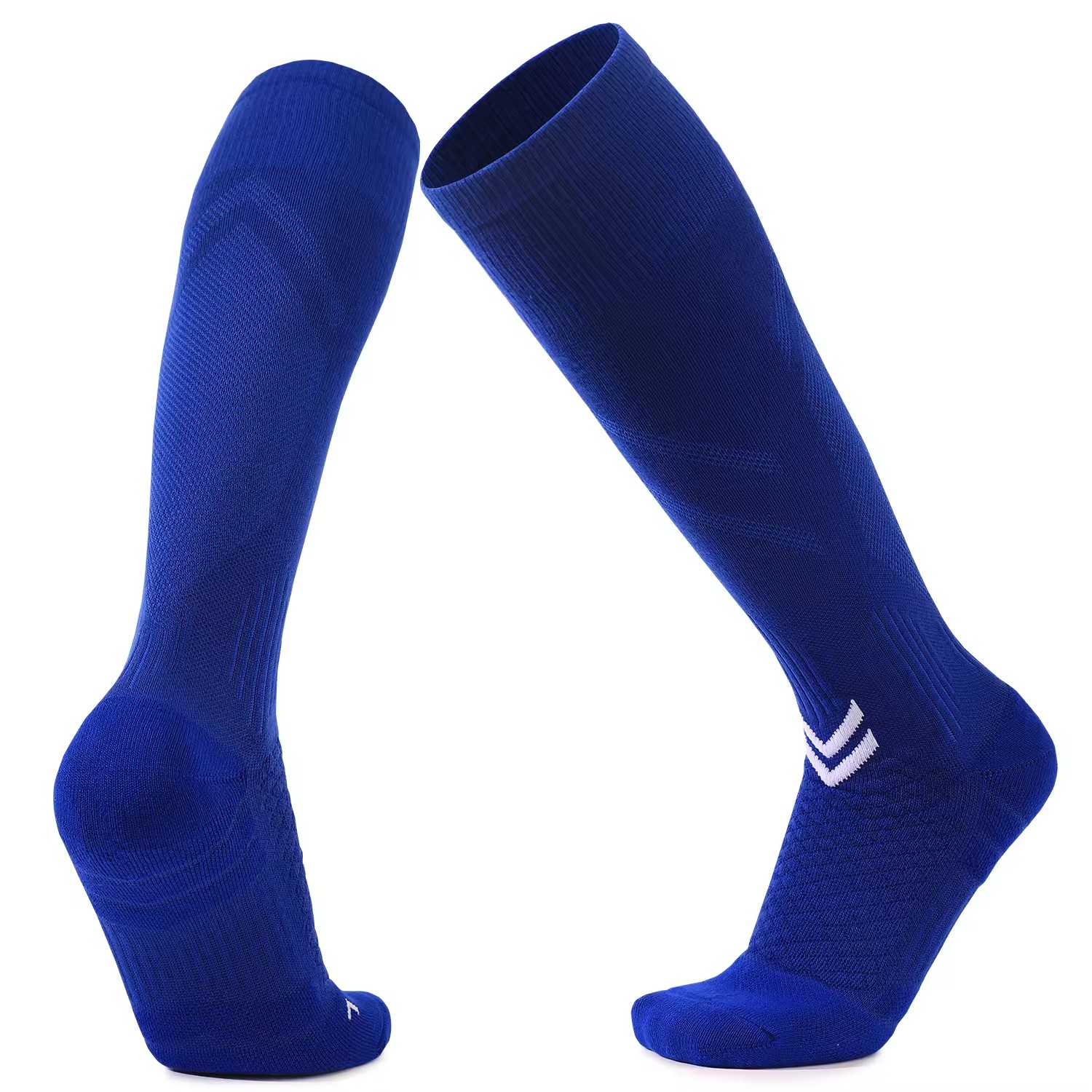
Football Socks Factory Secrets: How Premium Match-Day Socks Are Crafted
2026-11-16
Match-day socks aren't just another piece of kit—they’re a quiet engineering project. Every stitch, blister tab, and pressure zone in the pairs that hit the pitch starts with a decision most fans never see. I went inside the production line at Mingjun, one of the specialized football sock factories, to trace exactly how premium socks go from yarn to the tunnel. What happens before kick-off is more deliberate than you’d think.
The Yarn Blend Nobody Puts on the Packaging
Most yarn labels list a fiber content, but there is usually a small portion of the blend that never gets printed on the band. Mills routinely slip in a low percentage of something unexpected—nylon for resilience, acrylic to keep the price down, or a recycled fiber that subtly changes the hand. Labeling rules allow rounding and broad categories, so that hidden ingredient stays invisible.
This unnamed part of the blend does more than you might think. A quiet 5 percent can shift how the yarn drapes, how it pills, or even how it takes dye. When a project doesn't behave, the instinct is to blame the pattern or the needle size, but the real culprit is often the unlisted fiber doing its own thing.
Rather than waiting for perfect transparency, you can read the yarn itself. A quick burn test, a close look at the twist, or a gentle stretch can hint at what is really inside. The packaging may stay silent, but your fingers will pick up the story.
Inside the Knitting Room Where Tension Becomes Traction
In the corner of the workshop, the air smells of wool and machine oil. The knitting room is small, but every surface carries the marks of repetition—smooth grooves in the wooden table, a faint sheen on the yarn guides, and the steady rhythm of needles that never quite pauses. Here, tension is not an enemy to be eliminated. It is the raw material of the craft. Each thread is pulled just enough to hold its shape, but not so much that it snaps. The difference between a loose, shapeless fabric and one that springs back with purpose lives entirely in that invisible line of pull.
What looks like strain from the outside becomes structure in the hands of someone who understands the room. The tension in the yarn is not a sign of stress; it is the mechanism that turns soft fibers into a surface capable of holding weight, resisting wear, and moving with the body. The knitter reads the resistance through fingertips before the eyes ever confirm it. Too slack, and the stitches collapse into ambiguity. Too tight, and the fabric turns brittle, unwilling to bend. The craft is less about forcing the thread and more about listening for the point where resistance becomes readiness.
Step back from the machinery, and the same logic applies beyond the room. The pressures we carry—tight schedules, conflicting demands, the stretch between what we know and what we attempt—are not there to be eliminated. They exist to be directed. A knitting room teaches that traction comes from tension managed, not tension avoided. The thread does its best work when it is held firmly enough to catch every loop, yet freely enough to keep moving. That balance is not a one-time adjustment. It is a constant, hands-on negotiation. And it is exactly where the useful strength gets made.
How Cushion Zones Are Mapped to a Player's Foot Strike
Mapping cushion zones to a player's foot strike starts with pressure-mapping insoles and high-speed cameras. Designers watch exactly where the heel, midfoot, or forefoot hits first and how force travels through the shoe during a stride. That data gets turned into heat maps, with red spots marking high-impact areas and blue showing lighter contact. Rather than padding the whole sole evenly, builders place firmer or softer foam only where the foot actually needs it.
The real trick is accounting for different strike types. A heel striker wants extra shock absorption under the rearfoot, while a forefoot runner benefits from a responsive toe-off zone and a slightly firmer heel for stability. Midfoot strikers often need a balanced blend across the arch and ball. These aren't guesses; they come from studying dozens of players with similar mechanics and then tweaking foam density, thickness, and shape until the transition feels natural.
What makes modern setups stand out is how the zones are blended, not just bolted together. Instead of hard lines between soft and firm areas, builders use gradient foams or geometric cutouts that let energy roll smoothly from landing to push-off. If a player tends to overpronate, the medial side might get a denser wedge, but it's sculpted to avoid a sudden bump. The goal is a shoe that matches foot strike so closely it disappears underfoot.
The Compression Sweet Spot That Keeps Socks From Slipping
Most slipping happens because the sock’s grip around your calf is either too aggressive or barely there. The fix isn’t more elastic; it’s finding the narrow band of pressure that holds the fabric in place without leaving a deep mark on your skin. That band usually sits just below the calf muscle, where the leg’s shape changes and gives the knit something to anchor against.
A well-made sock pairs this targeted compression with a ribbed arch or a reinforced heel pocket, so the tension travels with your foot instead of fighting it. When the weave has just enough recovery, the sock can stretch through a full stride and snap back without sliding down the ankle. It feels snug at first, then disappears as the fibers warm up.
Look for socks that mention a “firm but forgiving” cuff or a contoured leg. If you can slide a finger under the top edge without a struggle, and the sock still stays put after an hour of walking, you’ve hit the sweet spot.
Why Match-Day Socks Go Through a Sweat Chamber Before Shipping
Match-day socks are not shipped straight from the knitting line. Before they reach a player’s kit bag, each batch is placed inside a controlled sweat chamber that simulates the heat, moisture, and friction of a full ninety minutes on the pitch. This step is not about checking for cosmetic flaws—it is about confirming that the fabric can handle repeated exposure to synthetic perspiration without losing its grip, stretch, or shape.
Inside the chamber, socks are pulled over anatomical foot forms and exposed to a warm, humid airflow while a saline solution is sprayed at intervals. The chamber also flexes the ankle and toe areas to mimic sprinting and cutting movements. Technicians log moisture pickup, drying time, odor retention, and seam integrity. Any pair that develops slippage, bunching, or excessive dampness is pulled from the line.
Only after passing this sweat test are the socks packed and released. It might sound excessive, but match day leaves no room for adjustment. A sock that fails on a training pitch can be swapped; a sock that fails in the 80th minute can cost a team the game. The sweat chamber exists so that neither player nor kit manager has to think about their socks when the whistle blows.
The Hand-Finished Details That Separate Pro-Grade From Retail
Factory lines stop at dimensional tolerances, but a pro-grade piece keeps going after the machine shuts off. You can feel it in the rolled edge of a pickup cavity, where someone spent an extra twenty minutes with a fine file just to make the wiring route feel intentional. Or in the way a neck joint is hand-scraped until the finish sinks into the grain instead of sitting on top like a plastic film. These aren't visible in a spec sheet, but the first time you run your thumb along a seam and find no ridge, you'll know why it costs what it does.
Retail versions often mimic the look—same shape, same color—but skip the quiet hours of burnishing, leveling, and tapping. A pro builder will mask off cavities with thin paper tape, not blue plastic, so the paint doesn't creep under the edge. They'll sand fret ends with a slight back-angle, not just a quick roll, so your hand doesn't catch a sharp corner during a fast run. The hardware is torqued in sequence, not just snugged down, leaving every screw slot aligned to the body line. None of it shows in a photo, but pick up two instruments side by side and the hand-finished one will make the other feel like a rough draft.
FAQ
Most of it comes down to yarn blend and stitch density. Premium versions tend to use a higher percentage of mercerized cotton or a fine-gauge synthetic like polyamide, and the knitting machines are set to produce more stitches per inch. That tighter construction improves fit around the foot, reduces bulky seams, and helps the sock hold its shape through a full match instead of loosening after the first hard sprint.
Cotton still shows up for comfort, but pure cotton soaks up sweat and stays damp. Factories usually blend it with hydrophobic yarns in the sole—think nylon or polypropylene—and add a touch of elastane. The synthetic yarns pull moisture away from the skin and speed up drying, while elastane keeps the sock from sliding around inside the boot.
Most of it is structural. The sole is often knitted with a terry loop or mesh channel pattern that creates air gaps and gives sweat a path to move outward. Some factories also use yarn-level wicking, where the inner layer is a hydrophobic fiber and the outer layer is more absorbent. That mechanical approach lasts longer than any surface treatment because it doesn't wash out.
The best match-day socks are knitted as a continuous tube on modern circular knitting machines. The toe is usually closed with a hand-linked or automatic linking process to avoid a raised seam across the toes. Separate panels are rare because every seam is a potential friction point when a player is cutting and changing direction.
Factories typically run abrasion tests on the heel and toe, stretch recovery tests on the cuff, and wash cycle tests to check shrinkage and colorfastness. Some also do a fit trial on last-shaped foot forms that mimic a foot inside a football boot. Batches get pulled if the sock loses elasticity too quickly or if the toe seam fails after repeated flexing.
That's not just sizing—it's engineered. The knitting program includes zones with higher elastane content or a tighter stitch pattern around the midfoot and ankle. This gives a slight compressive feel that supports the arch and keeps the sock from twisting during lateral movement. It also helps prevent the sock from bunching up inside the boot.
Sometimes, but more often they focus on universal high-impact areas: the heel, the ball of the foot, and the toe. Some brands ask for extra terry cushioning under the forefoot for forwards or extra heel padding for defenders, but that's usually a custom order. Standard premium production keeps the padding balanced so the sock works for any position.
The knitting machine tension and the yarn specs are locked into the production file for each size. Even when colors change, the same base yarn count and stitch program are used. After knitting, socks are steam-set on foot-shaped boards at controlled temperatures so the dimensions stabilize. That prevents a black pair from coming out tighter than a white pair just because the dye affects the yarn differently.
Conclusion
The real story behind premium match-day football socks starts long before any player pulls them on. The yarn blend is never printed on the packaging, yet it defines everything: a careful mix of high-tenacity nylon for durability, mercerized cotton for a soft touch, and a hidden filament of elastane that keeps its memory through ninety brutal minutes. Inside the knitting room, machines run on tension profiles tuned by hand—not just to hold shape, but to create zones of micro-traction under the arch and heel, so the foot grips the boot without sliding. Cushion zones aren't randomly placed; they follow a strike map drawn from slow-motion footage of real footfalls, padding the metatarsal heads and the lateral heel strike where impact peaks.
What separates pro-grade from retail is the compression sweet spot: just enough graduated pressure up the calf to prevent the sock from slipping down, but not so much that it cuts circulation or changes a player's stride. Before shipping, every batch goes through a sweat chamber—a humidity and heat cycle that simulates a full match, checking for shrinkage, dye bleed, and odor retention. Then comes the hand-finished pass: toe seams are linked flat, not stitched into a ridge, and any loose thread is trimmed by a worker who checks stretch recovery along the shin and ankle. These details never appear on the label, but they're why a factory sock feels like a second skin, not a souvenir.
Contact Us
Contact Person: Tiga
Email: [email protected]
Tel/WhatsApp: 8613058331729
Website: https://www.china-socksfactory.com/