
China Switchgear Tulip Contact Types and Selection Criteria for Industrial Use
2026-10-03
Tulip contacts sit at the core of medium-voltage switchgear, but they rarely get attention until a hot spot or loose connection forces a shutdown. In China's industrial sector, several tulip contact types dominate the market, each with different trade-offs in conductivity, insertion force, and thermal stability. This post strips away the guesswork and walks through the selection criteria that matter most for reliable industrial operation. If you're comparing contacts for a new build or retrofit, MOLDVOLT supplies practical options aligned with the specifications covered here.
Tulip Contact Types You’ll Encounter in China’s Switchgear Market
In China's medium-voltage switchgear sector, tulip contacts serve as the primary interface between withdrawable circuit breakers and the busbar compartment. The term covers a family of multi-finger, spring-loaded connectors that ensure reliable current transfer even under misalignment or vibration. While many catalogs lump them together, three distinct configurations dominate the market: the classic screw-fixed tulip with individual contact fingers, the integral spring-cage tulip, and the increasingly popular strap-type or lamella design. Each brings its own trade-offs in terms of installation effort, contact resistance, and tolerance for frequent racking operations.
The screw-fixed tulip remains the workhorse in older switchgear designs. Here, each finger is a separate silver-plated copper strip bolted onto a central hub, and a garter spring wraps around the outer circumference to maintain contact pressure. It's inexpensive and easy to repair finger by finger, but the bolted joints can loosen over time, and the exposed spring is vulnerable to mechanical damage during racking. By contrast, the integral spring-cage type embeds the fingers and the spring inside a machined sleeve, so there are no external fasteners to work loose. This configuration handles higher short-circuit forces more gracefully, though it's noticeably more expensive and not field-serviceable in the same piecemeal way.
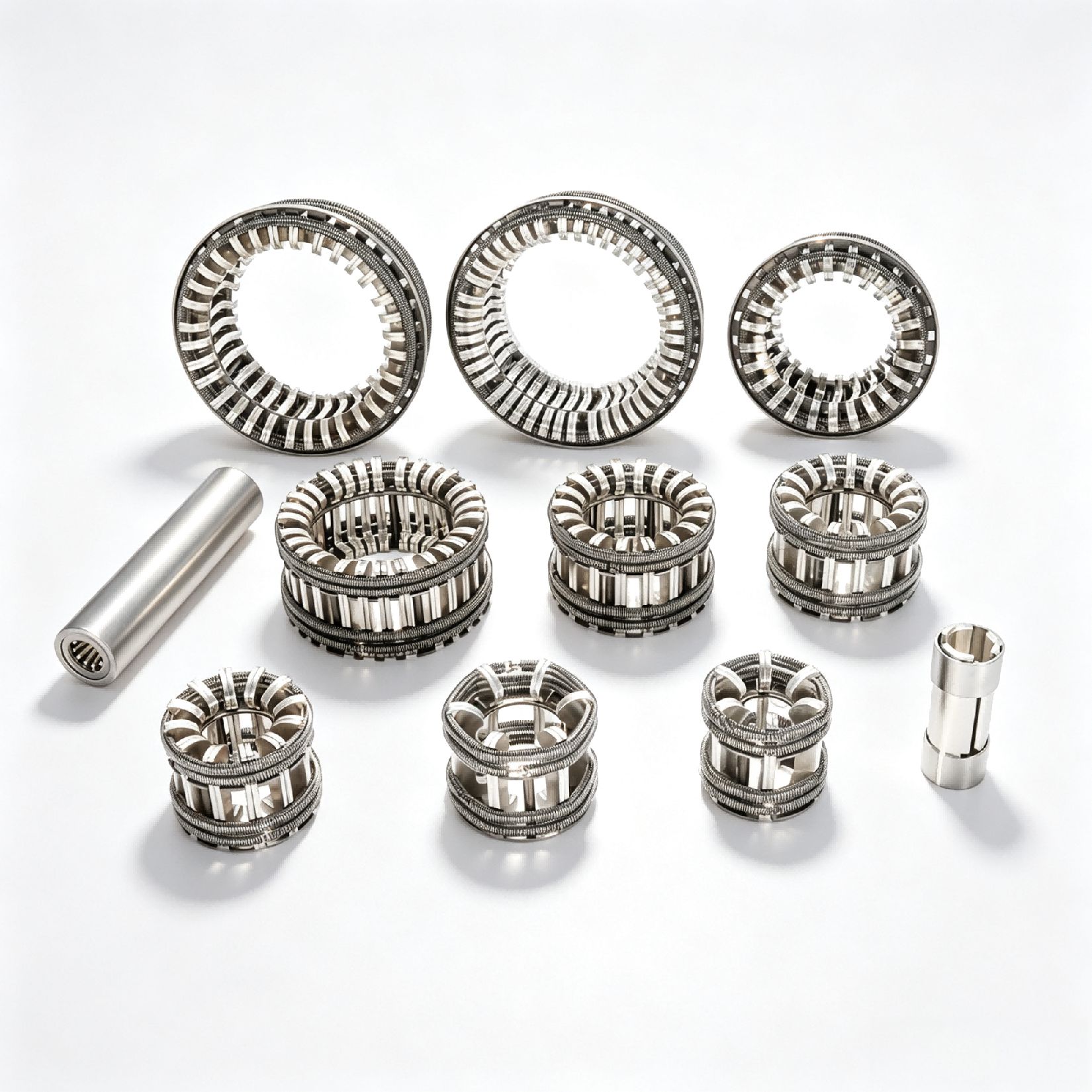
A third variant, the strap or lamella contact, uses dozens of thin, angled copper leaves arranged in a cylindrical basket. This design excels at low contact resistance per unit length and tolerates angular misalignment far better than finger-based types, which is why it's quickly gaining ground in modern air-insulated switchgear. When selecting among these types for a retrofit or new build, buyers in the Chinese market typically weigh the breaker's racking frequency, the rated continuous current, and the availability of local spare parts. No single tulip type wins outright; the right choice depends on whether you prioritize upfront cost, long-term reliability, or ease of maintenance in a specific operational environment.
Why Plating Thickness Often Determines Contact Longevity
In connector design, the relationship between plating thickness and contact life isn't linear, but it's rarely ignored. A thicker deposit can absorb more mechanical wear before base metal is exposed, which means the contact keeps its low-resistance interface through more mating cycles. Once the plating layer is breached, oxidation and fretting corrosion start to dominate, and resistance climbs quickly.
That said, simply adding more plating doesn't automatically produce a longer-lasting contact. The benefit shows up where motion and pressure concentrate—thin gold over nickel, for instance, can wear through in a few hundred cycles under sharp edge contact, while a heavier gold layer may survive thousands. The key is matching thickness to the actual stress pattern, not just using a generic 'more is better' rule.
There's also an economic tradeoff that influences longevity in practice. Plating precious metals costs money, so designers often push thickness down to the minimum that survives validation. When conditions change slightly—higher vibration, more frequent mating, or a harsher atmosphere—that thin layer becomes the weak point. Contacts don't fail from the bulk alloy; they fail at the surface, which is why plating thickness often ends up deciding when a connector reaches the end of its useful life.
Matching Current Ratings to Real Load Profiles
Most installed equipment never draws a flat, predictable current. Even a motor running at a steady torque shows small fluctuations, and loads like compressors, pumps with varying head, or welding stations swing far more. Picking a current rating from a nameplate or a generic table often misses how that current behaves over time. A fan might sit at 70% of its label most of the day but spike to 140% for a few seconds during startup. If you size protection for the spike alone, the system ends up overbuilt; size for the average and you risk nuisance trips or thermal aging. The real work is reading the current trace and deciding what the equipment actually needs to survive, not what a single snapshot suggests.
One practical approach is to sample the load over a representative duty cycle and compute the true RMS heating effect, including harmonic content where relevant. A variable-frequency drive, for instance, can pull a distorted current waveform that generates more heat in cables and breakers than a simple sine wave with the same fundamental reading. In those cases, the current rating has to account for extra losses, not just the displayed amps. Similarly, a bank of LED drivers may draw sharp inrush pulses dozens of times a day, each lasting only milliseconds. The right breaker or fuse rating isn't the inrush peak, but a value that handles the thermal accumulation without tripping. Matching ratings to real profiles means treating current as a dynamic signature rather than a fixed number.
Spring Pressure, Wear, and the Long Game of Contact Life
Initial spring force sets the baseline for how firmly mating surfaces press together. Too little pressure and microscopic bounce or fretting can start early, shaving life off the contact before it has a chance to settle. Too much pressure, though, accelerates mechanical wear and can deform the plating or the base metal underneath.
Wear doesn't happen in a straight line. The first few thousand cycles often show the highest rate of material transfer, as surface roughness gets smoothed down and oxide layers are broken through. After that, the contact enters a steadier phase where the spring's residual energy and the contact geometry determine how evenly the load is distributed.
Over the long run, the game is about managing decline. Spring relaxation, erosion, and micro-cracking in the plating all nibble away at the original design margin. A contact that starts with slightly more preload than the minimum required tends to hold its performance longer, not because it avoids wear entirely, but because it spreads the damage over a larger area and keeps enough force in reserve to maintain a reliable connection.
When Humidity, Dust, and Vibration Start to Matter
It's easy to overlook environmental stress when a product sits on a bench in a clean, dry lab. Move that same device into a concrete plant, a coastal shipping container, or the back of a flatbed truck, and suddenly humidity, dust, and vibration stop being abstract specs. Dust finds its way into every unfiltered intake, humidity condenses on cold metal surfaces overnight, and vibration turns every fastener into a slow-motion fatigue test. That's when the real design work begins.
Humidity is rarely just "moisture in the air." It's the dew that forms when temperatures drop after sunset, the corrosion that creeps along battery terminals, and the invisible film that invites leakage currents on high-impedance boards. Dust isn't just dirt—it's an abrasive that scores fan bearings, a blanket that traps heat on heat sinks, and a conductor when it mixes with oil or moisture. Vibration is the patient one: it doesn't break a bracket on day one, but it works solder joints back and forth until they crack, and it slowly backs out every screw that wasn't locked down with purpose.
The best hardware isn't designed for a clean room. It's designed for the least predictable moment: the dusty harvest run, the monsoon-season install, the generator trailer rattling over washboard roads. If you're not thinking about humidity, dust, and vibration before they show up in the field, you're not designing—you're just hoping. And hope doesn't survive a season of real-world operation.
A Practical Guide to Choosing Contacts for Heavy Industrial Duty
When you're selecting contacts for heavy industrial environments, the first thing to ignore is the glossy spec sheet headline. What actually matters is how the contact behaves after ten thousand cycles under load, coated in dust, and vibrating at 40 hertz. Look past the nominal current rating and ask for test data showing contact resistance drift over time—many vendors won't volunteer it unless you push.
Material pairing gets overlooked until a line goes down at 3 a.m. Silver cadmium oxide handles arc erosion well but faces environmental restrictions in some regions. Silver tin oxide is a common substitute, yet its higher contact resistance can create hot spots in compact switchgear. If you're dealing with frequent inrush currents or motor loads, consider silver tungsten or tungsten-copper blends—not because they're exotic, but because their erosion pattern is predictable, and predictability is what keeps maintenance crews from improvising.
Mounting and wipe matter more than most design guides admit. A contact that looks robust on a bench can fail early if the carrier allows side slap or if the overtravel is set too low. On vibratory feeders, crushers, or punch presses, use rigid silver alloys rather than plated copper bases—plating flakes under repeated impact, leaving bare copper to oxidize and weld. And don't skip the thermal imaging check after a warm-up run; it reveals uneven blade seating before it becomes a burned contact tip.
FAQ
A tulip contact is a multi-finger, spring-loaded connector used inside medium and high voltage switchgear to carry current between movable breaker trucks and fixed busbar stubs. The contact fingers are arranged in a circle and slightly flared at the entry, so from the front they look like a tulip flower, which is where the name comes from. The spring ring around the outside presses each finger inward for stable contact pressure.
Chinese manufacturers typically divide them by contact finger count, current rating, and spring style. Common types include 12-finger and 24-finger configurations for vacuum circuit breakers from 630 A up to 4000 A, as well as specialized models with double coil springs or leaf-spring retainers. Some are made for plug-in disconnectors, others for fixed busbar joints. The most widely used industrial variants are the cylindrical tulip with an internal compression spring and the slotted tulip with individual finger springs.
Start with the rated current and short-time withstand current of the switchgear, not just the normal load. The contact must handle the full rated current without overheating, typically no more than 65°C rise at the connection point under IEC or GB standards. Then check the finger count, cross-section, and spring force. For 1250 A breakers, a 12-finger contact with silver plating is usually enough, but 2500 A and above generally needs 24 fingers or thicker copper fingers and possibly forced ventilation in the compartment.
The base material is usually T2 copper or chrome-zirconium copper for better elasticity at high temperature. Silver plating is almost universal, with thickness ranging from 6 to 12 microns for industrial use. Thicker plating, around 10 to 12 microns, makes sense in humid or chemically aggressive environments. Some manufacturers also offer tin plating for low-cost low-voltage cabinets, but that is not recommended for medium voltage because of higher contact resistance and faster oxidation.
The spring is what holds the contact fingers against the mating stud, so its force and fatigue life decide long-term performance. Helical garter springs are common and inexpensive, but they can lose tension after repeated insertion cycles or at high temperature. Better industrial contacts use double rings or a band of chrome-vanadium steel with a retaining groove. The spring should maintain enough radial force so each finger presses with 20 to 40 N, but not so much that insertion and withdrawal become difficult.
Yes, reputable Chinese manufacturers usually design to GB/T 11022, GB 3906, and the equivalent IEC 62271-1 and IEC 62271-200. The contacts are expected to pass temperature rise tests, short-time withstand current tests, and mechanical endurance tests. For industrial buyers, it is wise to ask for type test reports showing contact resistance below about 40 micro-ohms per joint and silver plating thickness verified by X-ray fluorescence.
The most frequent failures are overheating from weak spring force, oxidation or sulfidation of silver plating, uneven finger alignment after misaligned insertion, and fretting corrosion from vibration. Overheating usually shows up as discolored or blued copper fingers. To prevent failures, check insertion depth, make sure the mating stud is clean and centered, avoid excessive insertion cycles without inspection, and replace any contact set that shows spring deformation or plating wear beyond 20 percent of the finger surface.
Chinese tulip contacts are often 30 to 50 percent cheaper than equivalent European or Japanese parts, mainly because local copper and labor costs are lower and production volume is high. That does not automatically mean lower quality. Many factories export to major switchgear OEMs. However, quality control varies widely, so it is important to verify material certificates, plating thickness, spring force test data, and third-party inspection before buying. Avoid unbranded contacts that only provide a dimension drawing without electrical test data.
Conclusion
When specifying tulip contacts for switchgear in China, the range of designs goes well beyond a generic “cluster” style. Petal-type, coil-spring, and disc-spring variants each respond differently to short-circuit forces and insertion wear. Plating thickness is often the first thing to fail in the field: a silver layer below 10 µm can wear through after a few hundred operations, exposing copper and inviting oxidation at the worst moment. Rather than trusting nameplate current ratings, it pays to map the real load profile—motor inrush, harmonics, and unbalanced phases all push contact temperature higher than lab tests suggest.
Spring pressure and mechanical wear need to be considered together. High pressure lowers resistance but shortens the contact’s working life if the spring loses force after repeated operations. In humid, dusty, or vibrating environments, that wear accelerates through fretting corrosion and surface contamination, so pore-free plating and stable alignment become more important than initial contact resistance. For heavy industrial duty, a practical rule is to choose tulip contacts with at least 20 µm silver plating, replaceable springs, and evidence of passing humidity cycling and vibration tests—not just the lowest bid.
Contact Us
Contact Person: Hellen
Email: [email protected]
Tel/WhatsApp: 86-13634205622
Website: https://www.voltcabinet.com