
China Aluminum Alloy Antistatic Floor: The Ultimate Guide to Safe and Durable Flooring
2026-09-02
When it comes to industrial and commercial spaces where static electricity can wreak havoc, few flooring solutions match the precision and resilience of China's aluminum alloy antistatic floors. In this guide, we'll unpack why these high-performance surfaces—backed by manufacturers like Lipin Floor—are becoming the go-to choice for facilities that demand both safety and long-term durability. From data centers to cleanrooms, get ready to discover how the right floor can safeguard sensitive equipment and your bottom line.
Why Aluminum Alloy Beats Steel and Vinyl for Raised Flooring
Steel raised floor panels bring serious load capacity, but that strength comes with a weight penalty that drives up structural support needs and labor costs. Vinyl, on the other hand, is featherlight but dents and flexes under rolling loads or heavy equipment, leading to premature replacement. Aluminum alloy splits the difference in the best possible way: it delivers near-steel load ratings at roughly one-third the weight. This means fewer support pedestals, faster installation, and a floor system that doesn't punish the building's framework over time.
Corrosion is another area where aluminum quietly outperforms both alternatives. Bare steel rusts unless galvanized or coated, and any scratch in that protection becomes a starting point for decay. Vinyl may not rust, but it scratches, chips, and absorbs stains, especially in high-traffic or chemical-exposed environments. Aluminum naturally forms a thin oxide layer that resists moisture, salts, and many industrial chemicals without any additional finish. Once installed, it essentially takes care of itself.
There's also the thermal and lifecycle story. Aluminum conducts heat far better than steel or vinyl, which makes it ideal for data centers and labs where underfloor air distribution depends on consistent thermal exchange. And at end of life, aluminum can be recycled indefinitely without losing its properties, while vinyl flooring typically ends up in a landfill and may off-gas volatile compounds during its service life. When you add up installation savings, maintenance avoidance, and end-of-life value, the aluminum option stops looking like a premium choice and starts looking like the only rational one.
How the Antistatic Surface Keeps Your Server Room From Failing
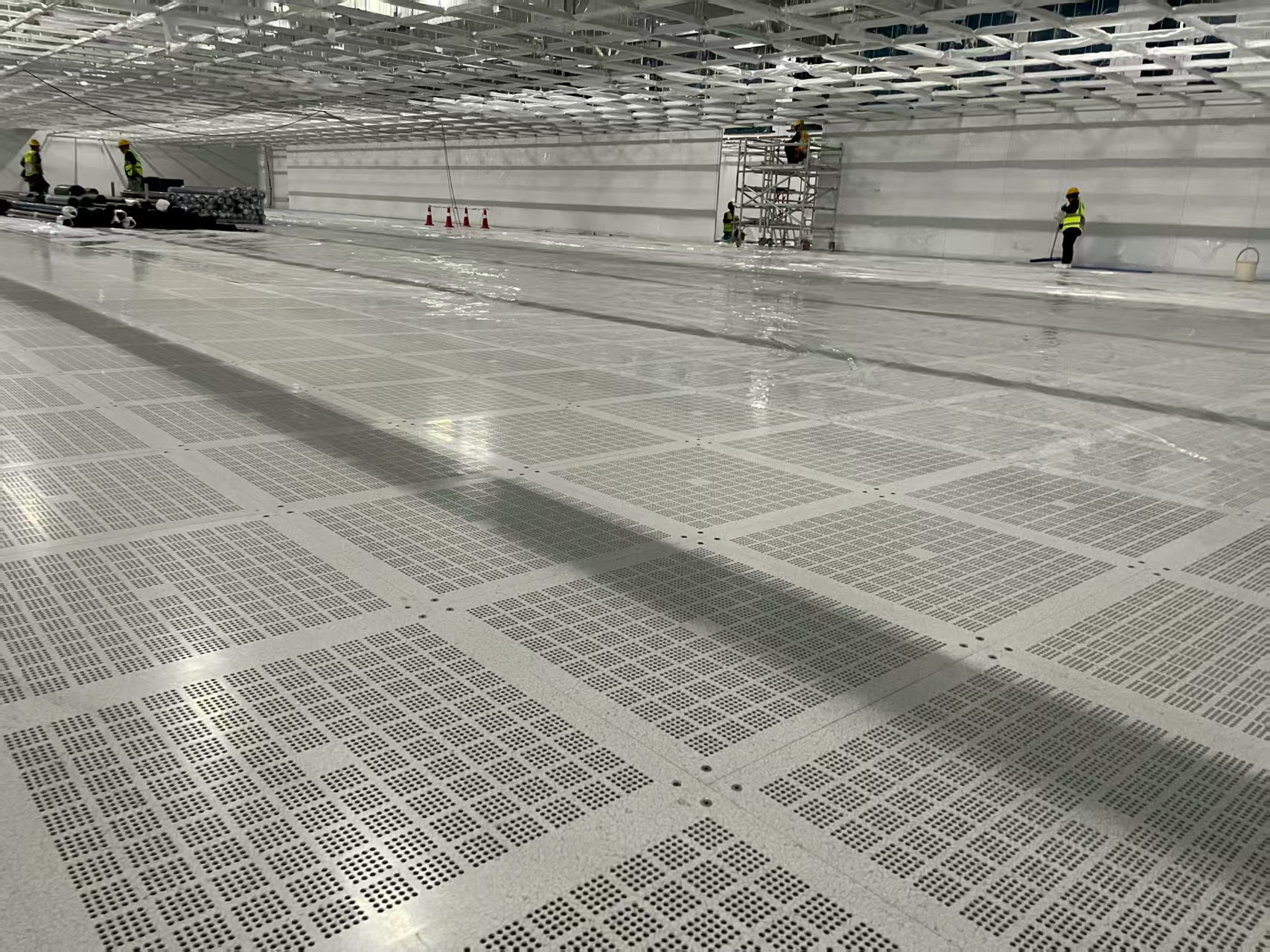
Static electricity is not just a nuisance; it's an invisible threat. In a server room, every footstep across ordinary vinyl or carpet can generate hundreds or thousands of volts. When that charge jumps to a server chassis or a circuit board, the sudden current can corrupt data or burn out sensitive transistors. An antistatic surface changes the game by providing a controlled path for electrons to bleed away before they build up enough to arc.
Most antistatic surfaces blend a low-conductivity material into the top layer, such as carbon fibers or metal particles. This creates a network that doesn't fully conduct, but instead allows charge to migrate slowly to a grounding point. That distinction matters: a highly conductive floor could create a shock hazard, while a purely insulating floor traps charge. The antistatic balance keeps the room safe for both people and equipment.
When static is no longer accumulating on floors, workbenches, and even wall panels, the failure rate of servers drops noticeably. Memory errors, random reboots, and unexplained port failures often trace back to electrostatic discharge. By swapping out standard flooring for antistatic tile or laying down grounded mats, you remove one of the most common yet overlooked causes of downtime. It's a quiet fix that keeps critical systems running without constant intervention.
Thickness, Coating, and the Real Price of Cheap Panels
When a panel feels reassuringly heavy, most people assume they’re getting more metal for their money. That’s only half the story. Thickness does matter—thicker gauge steel resists dents and doesn’t oil-can when the sun hits it—but a thick panel with a lousy coating will still rust through long before a thinner, well-finished one. The real cost hides in the chemistry, not the calipers.
Cheap panels often skip the zinc-rich primer or use a single baked-on polyester that looks glossy in the showroom but surrenders to UV and moisture inside five years. Premium coating systems layer a phosphate etch, an epoxy primer, and a ceramic-infused topcoat. That stack costs more upfront, but it means the panel doesn’t start flaking around the fasteners or staining below the window line after two seasons of rain and road salt.
So when you compare prices, stop calculating dollars per millimeter of thickness. Ask what’s under the paint. A bargain panel that needs scuffing, priming, and repainting in three years isn’t cheap—it’s a deferred expense with a labor bill attached. Pay for the coating now, or pay for the consequences later.
From Data Centers to Cleanrooms: Where This Flooring Makes Sense
Data centers punish flooring with rolling server racks, constant foot traffic, and the ever-present risk of static discharge. Raised access panels with conductive or dissipative vinyl tops handle the load while giving cables a hidden path underneath. The surface stays smooth enough for equipment moves but never builds up a charge that could fry sensitive hardware.
Cleanrooms flip the priorities: here the floor has to stay quiet in terms of particle release and survive harsh cleaning routines. Seamless epoxy or polyurethane systems fit because they have no grout lines to trap dust, and they tolerate daily wiping with alcohol, peroxide, or specialty disinfectants. In semiconductor fabs and pharmaceutical suites, that combination of low outgassing and chemical resistance keeps both the room and the product in spec.
Installation Details That Stop Future Creaks and Loose Bolts
Most creaks and loosening bolts trace back to one thing: skipped prep work. Before you even pick up a wrench, clean every contact surface until it's bone dry and free of old grease, paint chips, or rust flakes. A wire brush and a quick pass with rubbing alcohol do more for long-term silence than any fancy torque wrench. If the mating faces aren't perfectly flush, add a thin layer of anti-seize or medium-strength threadlocker—but only on the threads, never on the head or washer. That way, the bolt seats fully instead of hanging up on friction, and you won't be chasing mysterious squeaks six months later.
Torque specs exist for a reason, but here's the part most guides leave out: you need to re-check them after the first real load cycle. Tighten everything to spec, drive or run the assembly for a short period, then back each fastener off a quarter turn and torque it down again in the correct sequence. For anything that sees vibration—engine mounts, suspension arms, rack bolts—this second pass crushes any micro-slip that happened during initial seating. And don't rush the sequence. A star pattern or manufacturer's order isn't a suggestion; it's the difference between a joint that stays tight and one that works itself loose one bolt at a time.
Finally, mark every critical fastener with a paint pen or torque stripe once it's set. This does two things: it gives you a visible reference to spot movement at a glance, and it forces you to slow down and actually finish the job. Loose bolts rarely happen all at once—they start with a single fastener backing off just enough to transfer load to its neighbors. That stripe catches the early warning before it turns into a rattling, groaning headache. If you're working with stretch bolts or one-time-use hardware, replace them every single time. Reusing a bolt that's already yielded is like expecting a snapped rubber band to hold your lunch together.
Daily Care Without Harsh Chemicals: Keeping the Finish Intact
Most surface damage happens slowly, not from a single mistake but from the steady drip of well-meaning routines. You reach for a familiar spray, wipe with a bit more force than needed, and months later wonder why the sheen has dulled or tiny cracks have formed. The truth is that a finish—whether on wood floors, lacquered tables, or sealed stone—responds best to restraint. Plain water, a barely damp cloth, and an immediate dry pass will often outperform any product promising a “deep clean.” Microfiber is your friend here, but only if it’s clean and free of fabric softener residue, which can leave a hazy film that traps dust.
When water alone isn’t enough, the next step should be the gentlest possible solution you can mix yourself. A few drops of mild castile soap or baby shampoo in a quart of lukewarm water, applied with a well-wrung cloth, lifts most grime without etching the surface. Avoid vinegar, ammonia, bleach, and any cleaner labeled “all-purpose” unless you’ve tested it on a hidden spot and waited a full day to see the result. Even natural acids like lemon juice or undiluted rubbing alcohol can soften certain sealers over time. The goal is to remove soil, not the protective layer itself.
Finally, let the finish dry completely before any object touches it, and consider a dry-buff with a soft cotton cloth to restore the natural luster. If you notice water beading less or the surface looking thirsty, don’t reach for a harsher cleaner—that’s a sign the finish simply needs reconditioning, not stripping. A high-quality polishing cloth and a tiny amount of mineral oil or a manufacturer-recommended conditioner, applied sparingly and buffed off fully, will renew the glow without introducing film buildup. The best daily care is often invisible: you walk by, see a smudge, and wipe it with a dry cloth before it bonds.
FAQ
Aluminum alloy panels are fully conductive, so static charges bleed off almost instantly instead of building up on surface coatings. They're also non-combustible and don't produce toxic smoke, which matters a lot in enclosed equipment spaces.
High-grade panels typically use die-cast aluminum with reinforced rib structures, so they hold up under constant caster traffic and can handle point loads of 1,000 kg or more without permanent deformation. Many Chinese manufacturers also offer protective HPL or PVC finishes that resist wear far longer than standard epoxy coatings.
Aluminum alloy gives you better conductivity and corrosion resistance in one material. Steel panels can rust if the coating is scratched, and calcium sulfate is more brittle. Aluminum keeps its antistatic performance across the full panel thickness, so even edge damage doesn't create an insulating spot.
You need proper grounding connections—usually copper foil or grounding braid attached to each pedestal and tied to a building ground. Panels must sit fully on stringers, and the pedestal height should be checked so there's no rocking. If any panel gets replaced, re-verify the conductivity path before putting the floor back into service.
It's mainly used indoors, but aluminum resists many chemicals and moisture better than steel. With sealed seams and a suitable surface layer, it can work in labs or light industrial areas. For constant water exposure, you'd need drainage and special pedestal treatment, but the panel itself won't delaminate like woodcore.
Check for full test reports covering surface resistivity, point load, and fire rating—ideally from third-party labs. Also ask about dimensional tolerance, because tight seams reduce rocking and static leakage. A good factory will show consistency across batches and provide custom cutting for panels, vents, and ramps without long lead times.
Use a surface resistivity meter set to measure resistance from panel surface to ground. The reading should typically fall between 1×10^6 and 1×10^9 ohms. Also test multiple points, especially near cuts and edges, to confirm the conductive path doesn't depend on a single coating layer.
Routine upkeep is straightforward: dry mopping or vacuuming, and wiping with a damp cloth and neutral cleaner. Avoid waxes or oil-based polishes because they can build an insulating film. If panels are scratched, conductivity usually remains since the whole material is conductive, not just a top layer.
Conclusion
Aluminum alloy raised flooring earns its place by doing what steel and vinyl cannot. Steel adds unnecessary weight and eventually rusts in humid environments, while vinyl surfaces wear down under rolling loads and lose their conductive path. A quality aluminum panel stays flat under heavy equipment, resists corrosion, and carries static charges safely to ground through a built-in antistatic layer. That single detail prevents the random reboots, data errors, and hardware failures that plague server rooms. However, thickness and coating are where cheap panels fall apart. Thin aluminum skins over soft cores dent easily, and bargain coatings often wear off within months, leaving the floor electrically dead and far more expensive to replace than a proper panel would have cost in the first place.
In data centers, laboratories, and cleanrooms, this flooring makes sense because it tolerates frequent equipment moves without cracking or shedding particles. Installation matters just as much as the material: uneven subfloors, skipped leveling pads, and under-torqued bolts create creaks, rocking panels, and loose connections over time. Using the right understructure support and checking bolt tension during the first few weeks prevents most of those headaches. Daily care stays simple—dry or slightly damp mopping with a neutral cleaner keeps the finish intact, while harsh solvents, abrasive pads, and strong acids can break down the antistatic coating. If you avoid those shortcuts, the surface keeps its conductivity and clean appearance for years.
Contact Us
Contact Person: yuki
Email: [email protected]
Tel/WhatsApp: +86 18664390732
Website: https://www.lipinfloor.com/