

Best Ultrasonic Spray Pyrolysis System for Uniform Thin Film Coatings
2026-10-20
Achieving uniform thin film coatings often feels like chasing a moving target—until you discover the right equipment. In this post, we explore what makes an ultrasonic spray pyrolysis system truly stand out, and why Siansonic has become a go-to name for researchers and manufacturers seeking consistent, high-quality results.
What Actually Determines Thin Film Uniformity in Ultrasonic Spray Pyrolysis
The uniformity of films deposited by ultrasonic spray pyrolysis is rarely governed by a single parameter, but by the competition between droplet coalescence and solvent evaporation at the deposition surface. When the aerosol reaches the heated substrate, the ideal situation is that droplets land, flatten, and merge into a continuous liquid film before the solvent escapes. If the solvent leaves too quickly—whether due to excessively high substrate temperature, very low precursor concentration, or long nozzle-to-substrate distance—droplets dry individually and form a powdery, discontinuous layer with high roughness. Conversely, if evaporation is too slow, the liquid can pool and migrate, creating thicker edges or leaving behind drying rings. Uniformity thus hinges on keeping the evaporation front just behind the advancing coalescence front.
Substrate temperature deserves special attention because it does not simply dictate "faster drying." Instead, it shifts the balance between wetting, spreading, and the onset of the Leidenfrost effect. At moderate temperatures, solvent wets the surface briefly enough for droplets to merge, yet evaporates quickly enough to avoid runoff. If the surface is too hot, droplets may rebound or skitter across the substrate due to an insulating vapor cushion, leaving behind isolated deposits and non-uniform patches. If it is too cold, the film remains wet longer, and capillary-driven flow toward the edges can cause the well-known coffee-ring effect at the macroscale, producing a thickness gradient across the sample.
Spatial uniformity is also determined by the overlap of consecutive spray passes and the inherent droplet flux distribution of the ultrasonic nozzle. Because the nozzle emits a roughly Gaussian spray profile, a single pass deposits more material at the center than at the edges. Without sufficient overlap, the result is a striped pattern of thicker and thinner bands. However, excessive overlap can cause double-coated zones and build-up at the turning points of the stage. Matching the step size to the measured droplet density profile—not to the nominal spray width—is often what separates films with a uniform interference color from those with visible fringes.
The Nozzle's Hidden Role: Atomization That Doesn't Drift
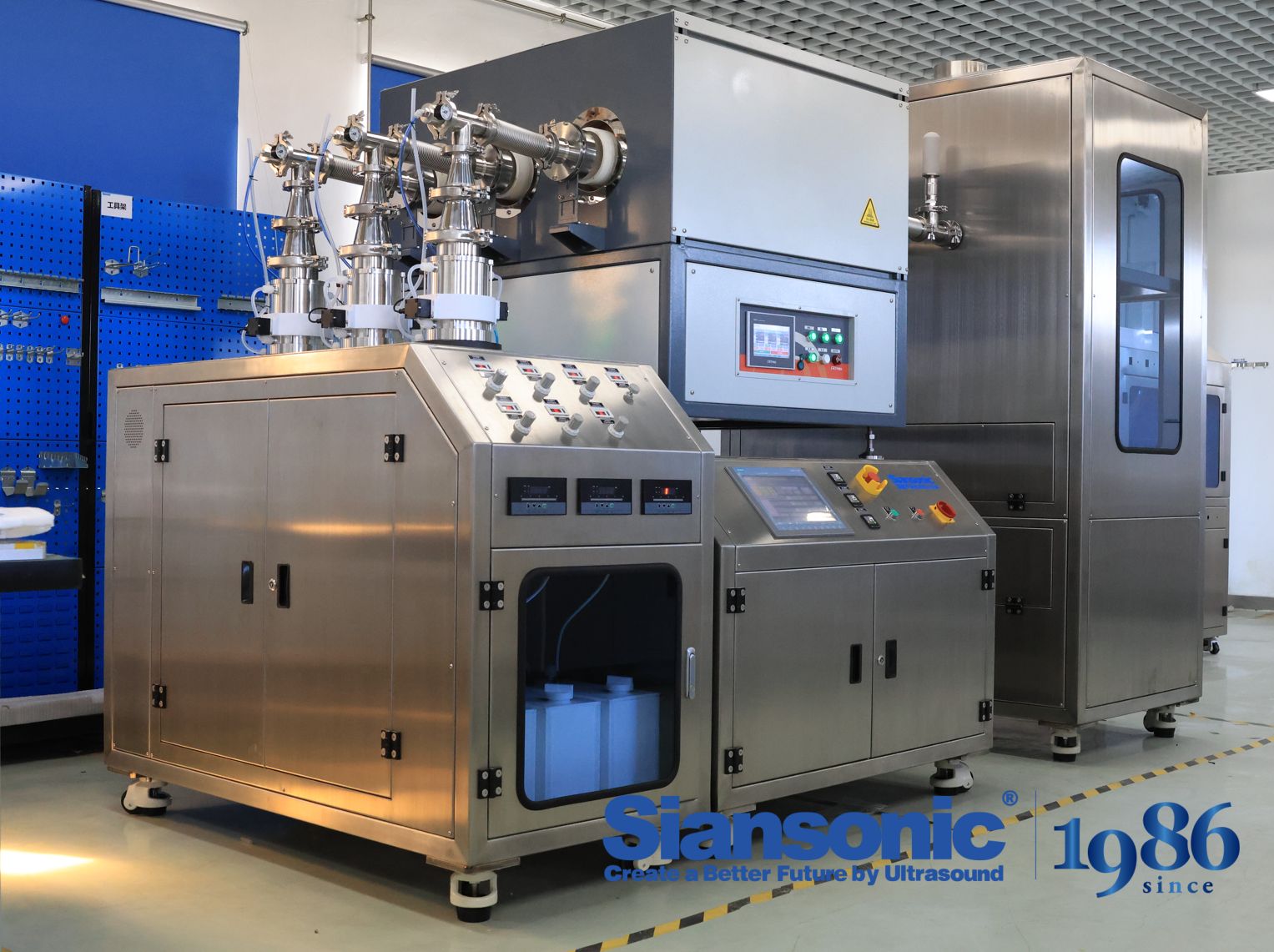
Most spray conversations fixate on pressure, speed, and spray volume. But the nozzle itself does much of the quiet work. Its internal geometry decides whether a liquid sheet shatters into a fine cloud or holds together as heavier droplets that drop where you aim them. Drift is not just a weather problem; it starts at the nozzle orifice.
Air-induction and pre-orifice designs are built for this exact reason. They pull air into each droplet, creating a coarser spray that resists becoming airborne mist. You lose some of that ultra-fine coverage, but you gain a pattern that stays put in a breeze. The trade-off is deliberate, and it works.
Matching the nozzle to the job means watching the droplet size class at your pressure range. A nozzle rated medium at 40 psi might turn fine at 70 psi. That hidden shift can undo your drift plan before you notice it. Choose the nozzle first, then let the pressure serve the nozzle, not the other way around.
Heating the Substrate, Not Just the Chamber: A Subtle but Critical Difference
Many thin-film deposition systems rely on chamber heating as a proxy for substrate temperature, but this assumption often leads to inconsistent film properties. The chamber wall may be at 300°C while the actual wafer surface sits tens of degrees lower, especially during early stages of growth. This gap affects adatom mobility, nucleation density, and residual stress in ways that are easy to overlook until a device fails.
Directly heating the substrate, either through a heated platen or backside IR lamps, closes that gap and gives you real control over the growth front. Even a 20°C difference can shift a perovskite film from smooth and compact to rough and porous. For compound semiconductors, precise substrate heating prevents unwanted phase segregation and improves interface sharpness.
The key is not just hitting a target number, but knowing where that number is measured. A thermocouple buried in a heater block is not the same as a pyrometer reading the wafer surface. When process engineers compare recipes between tools, this subtle distinction explains why identical chamber settings produce different film quality. Accurate substrate temperature measurement and control turn a routine deposition into a repeatable process.
Why Droplet Size Distribution Matters More Than Average Droplet Size
Average droplet size can hide dangerous non-uniformity. Two sprays with identical mean diameters may perform very differently if one delivers a tight cluster of droplets and the other a wide scatter. The average collapses that scatter into a single number, erasing the extremes that actually drive coating defects, drift, or uneven coverage.
Droplet size distribution exposes the full population: the fraction of fines prone to evaporation or off-target movement, and the fraction of coarse droplets likely to bounce or run. A narrow distribution means predictable behavior across the whole spray, while a broad one signals unpredictable performance even when the mean looks acceptable.
Engineers who tune solely to average diameter often miss this. A formulation change can leave the mean unchanged yet shift the tails enough to cause inconsistent film formation or clogging. Tracking the distribution reveals those shifts early, making it a more reliable control point for real-world outcomes.
From Homemade Rigs to High-Volume Systems: Where Uniformity Breaks Down
Homemade rigs survive on improvisation. A welder who pieced together a frame from scrap tubing knows exactly which bolt needs an extra quarter turn and which thermocouple reads six degrees high. That unrepeatable, personal calibration hides a lot of small variation. Move that same process into a high-volume system and the tacit knowledge vanishes. Machine parameters are now set once, and those settings assume every sensor, actuator, and material batch behaves exactly the same. The breakdown starts in the gap between operator intuition and standardized control.
In a one-off build, a 0.2 mm misalignment gets corrected with a file and a shim, and nobody writes it down. Run ten thousand units through automated fixtures and that same misalignment becomes a distribution. Supplier lots differ, tool edges wear over an eight-hour shift, ambient temperature drifts between morning and afternoon. Each variable adds a small deviation, and they do not cancel out—they compound. What looks uniform from a control room dashboard is actually a cloud of tiny differences, and the system is far less forgiving than a human who could nudge a part by hand.
Quality checks often miss the problem because sampling plans are built to catch big, obvious failures, not slow drifts or batch-to-batch shifts. The real weakness is not in the machines but in the assumption that scaling up means doing the same thing faster. High-volume manufacturing needs a different discipline: measuring variation before it turns into scrap, adjusting process windows around material realities, and accepting that perfect uniformity is a target, not a starting point.
Cleanability as a Feature: How Design Affects Long-Term Repeatability
Cleanability rarely gets top billing during the early stages of product design, yet it quietly determines whether a device can deliver consistent performance over hundreds of cycles. When surfaces hide residues in sharp corners or under overhangs, operators resort to aggressive scrubbing that gradually damages seals, coatings, and micro-textures. A well-conceived design treats every recess as a potential failure point—either eliminating it or making it accessible enough for a rinse to reach without disassembly.
The relationship between geometry and repeatability becomes most visible in fluid-handling systems. A slight taper on a bore, a minimal dead leg in a manifold, or a deliberate break edge on a machined port can mean the difference between a ten-second flush and a twenty-minute manual intervention. Designers who prototype cleaning routines alongside functional tests often discover that small changes—such as relocating a weld bead or switching from a threaded joint to a sanitary clamp—yield outsized gains in long-term consistency, because they remove the places where contamination hides and then releases unpredictably.
Beyond geometry, material choice and surface finish play equally decisive roles. Electropolished stainless steel resists biofilm attachment far better than a rough cast surface, but it costs more and demands careful handling. The most repeatable designs don't simply chase the smoothest finish; they match the surface to the expected residue, the cleaning chemistry, and the operator's actual habits. When cleanability is treated as a core feature from the first sketch, long-term repeatability stops being a hope and becomes a measurable, built-in result.
FAQ
The ultrasonic nozzle vibrates at high frequency to break the precursor into very fine, evenly sized droplets. Because the droplets are small and have low momentum, they land gently on the heated substrate and spread before decomposing, which reduces splashing and pinhole defects. Conventional air-assisted nozzles often produce a wider droplet size range and stronger impact, leading to rougher or less consistent films.
Focus on the stability of the ultrasonic generator, the precision of the liquid delivery pump, and how easy it is to adjust the nozzle-to-substrate distance. A heated substrate holder with uniform temperature control is just as important as the spray head. Systems that let you fine-tune flow rate, frequency, and scanning speed give you more control over final film quality.
The nozzle creates a soft, low-velocity mist rather than a forceful jet. This mist can be moved across the substrate in overlapping passes, so each point receives roughly the same amount of precursor. The narrow droplet size distribution means the solvent evaporates at a similar rate across the surface, which helps avoid thickness gradients and cloudy areas.
In most cases yes, as long as the solution viscosity stays within the nozzle's operating range and the precursor does not clog the tip. Common materials include metal oxides, doped films, and even some sulfides. You may need to adjust solvent type, concentration, and substrate temperature to match the chemistry, but the core setup remains flexible.
Flow rate of the precursor, substrate temperature, nozzle height, and scan speed are the main ones. The droplet size is mostly fixed by the nozzle frequency, but the other parameters determine how much material reaches the surface and how quickly it decomposes. Running several passes with lower flow rate often gives better uniformity than one heavy pass.
Clean the nozzle after every session, especially if the precursor tends to crystallize. Check the ultrasonic generator for frequency drift and inspect the liquid line for bubbles or blockages. Wipe the substrate heater to prevent residue buildup, and calibrate the pump regularly. Small problems in any of these areas show up quickly as uneven films.
It can be scaled up by using multiple nozzles or a moving gantry, but the most common systems are built for lab-scale substrates up to a few inches. Uniformity over very large areas requires careful thermal management and path planning. For research and pilot production, it works well; for full industrial-scale coating, you may need a custom configuration.
Transparent conductive oxides for solar cells, gas sensor layers, and protective coatings on glass all benefit from even thickness. Other uses include buffer layers in perovskite devices, anti-reflection coatings, and electrode materials for batteries. In these applications, thickness variation directly affects device performance, so a uniform spray is critical.
Conclusion
Uniform thin films from ultrasonic spray pyrolysis don't come from a single magic parameter; they emerge from how atomization, substrate temperature, and droplet dynamics interact. The most reliable systems treat the nozzle as more than a mist generator. A focused, non-drifting spray pattern keeps precursor delivery stable across the entire substrate, while the heating strategy targets the surface rather than merely warming the chamber air. That subtle difference lets droplets land, spread, and pyrolyze in a controlled sequence instead of drying mid-flight or pooling unpredictably. Even the droplet size distribution matters more than the often-quoted average size, because a narrow spread with fewer oversized or undersized droplets reduces local thickness variation and prevents splash-induced defects.
Scaling from a homemade rig to a high-volume tool usually exposes the same failure points: edge effects, inconsistent thermal zones, and residue buildup that silently shifts results run after run. A truly production-worthy ultrasonic spray pyrolysis system addresses these through cleanable fluid paths, accessible nozzle components, and predictable repeatability rather than relying on constant recalibration. When the design makes it easy to remove precursor residue and inspect the atomizer, long-term film uniformity becomes a repeatable outcome instead of a lucky batch. That combination of controlled atomization, substrate-focused heating, tight droplet distribution, and serviceability is what separates a dependable coating platform from a laboratory curiosity.
Contact Us
Contact Person: Ivy Zhang
Email: [email protected]
Tel/WhatsApp: +86 1081502288
Website: https://www.siansonic.com/