

Best Drop-Out Fuse Options for Reliable Overhead Line Protection
2026-08-14
Overhead lines face constant threats—from lightning strikes to sudden overloads. Yet many utilities still rely on outdated protection that leaves circuits vulnerable and maintenance crews scrambling. What if a simple, robust drop-out fuse could change that? In this post, we explore the best drop-out fuse options for dependable overhead line protection, and why a growing number of engineers are turning to Lugao for a solution that balances proven performance with smarter design. Whether you're upgrading an aging grid or hardening a new feeder, the right fuse choice can mean the difference between a brief flicker and a full-blown outage.
Why Drop-Out Fuses Still Beat Fancy Alternatives
There is something almost stubbornly honest about a drop-out fuse. When it blows, the hinged holder swings down, giving line crews an immediate visual cue that no diagnostic tool, no app, no wireless sensor can match. You can spot the problem from fifty meters away without touching a single wire. Fancy alternatives might promise remote monitoring or faster clearing times, but they often add layers of complexity that fail exactly when you need them most—during a storm, in the middle of nowhere, when the only thing that works is simple mechanical physics.
The cost argument rarely gets the attention it deserves. A drop-out fuse assembly costs a fraction of what a smart recloser or a vacuum interrupter setup runs, and replacement takes minutes with basic hand tools. Utilities that stick with drop-out fuses aren't being cheap; they're being pragmatic. The fuse link itself is a sacrificial element designed to fail safely, and the visible drop-open action confirms the fault clear without needing a SCADA ping or a battery that might have died six months ago. That reliability curve—flat and predictable for decades—is something no firmware update can promise.
Then there is the matter of repair philosophy. When a drop-out fuse operates, you know exactly what to do: replace the link, close the holder, and you're done. No need to send a technician with a laptop, no waiting for a specialized part from a vendor that stopped supporting last year's model. In rural co-ops and developing grid networks, this simplicity translates to shorter outages and happier customers. Fancy alternatives may look impressive in a boardroom slideshow, but on a rain-soaked pole at 2 a.m., the drop-out fuse still wins because it doesn't pretend to be more than a very good, very visible switch.
Porcelain or Polymer? A Lineman's Take
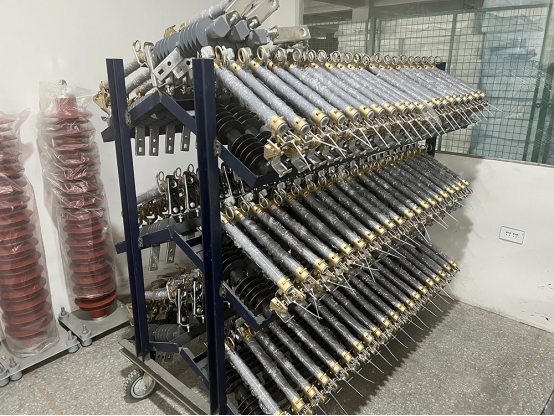
I've hung both kinds off the pole, and I'll tell you porcelain has a reputation that's hard to shake. You can spot a cracked porcelain insulator from the ground if the light hits it right, and that's a real advantage when you're doing routine patrols. But the weight? Hoisting a string of those bells up a tower in a stiff wind is a young man's game. Drop one and it's gone — shattered into a hundred pieces. Still, there's a reason the old-timers trust them: they've been on the line for decades and they don't care if the sun beats down all summer.
Polymer, on the other hand, feels like cheating when you first handle it. A stick of silicone rubber insulators is so light you can tuck it under your arm and climb with one hand free. No more worrying about a wrench slip turning into a porcelain grenade. But they're not perfect. Give them a few years of coastal salt spray or industrial grime, and you start seeing tracking and erosion on the sheds. I've pulled polymer strings that looked like a dog chewed on them after a lightning strike, while the porcelain next to it just sat there frowning.
So which do I prefer? Depends on the job. For new construction in remote country where the crew has to pack every pound on their backs, polymer is a lifesaver. For critical substation tie-ins or areas with heavy contamination, I'll still spec porcelain because I know exactly how it fails — and it fails slow, not all at once. The real trick is knowing your line's personality and not just following the catalog. A lineman's take isn't about what's new; it's about what keeps the lights on without calling me out at 2 a.m.
The Hidden Cost of Cheap Fuse Links
Many buyers treat fuse links as interchangeable commodity parts, grabbing the cheapest option off the shelf. But a fuse is a calibrated safety device, not a piece of wire. Low-cost versions often skip tight manufacturing tolerances, use thinner or inconsistent elements, and fail to meet the stated interrupting rating. The result can be nuisance blowing under normal inrush currents or, far worse, failing to clear a fault when it matters.
The real cost shows up later. A three-dollar fuse that does not open quickly enough can let a minor overload escalate into melted contactors, scorched busbars, or a full panel replacement. Then there is the downtime: a line stops, orders slip, and electricians spend hours tracing a fault that a quality fuse would have isolated cleanly. Cheap fuses also tend to age faster, so you replace them more often and still carry the risk of an unpredictable failure.
Mounting Angles and Blow-Out Behavior
The relationship between mounting angles and blow-out behavior often gets overlooked until a sidewall fails at highway speed. When a tire is seated at a steeper angle than the rim flange intended, the bead area experiences uneven stress concentrations. That stress doesn't stay local—it shifts as the tire heats up, and the flex point migrates toward the shoulder. Once the rubber compound loses its elastic recovery at that concentrated zone, a small internal tear can propagate outward. The result is rarely a sudden explosion; more often, you get a slow bulge, then a violent release when the weakened cords can no longer hold pressure.
I have seen tires with near-identical tread depth blow out at dramatically different mileages, and the common factor is usually the mounting angle. A slight misalignment—even a few degrees off the design seat—forces the casing to absorb energy in a way it wasn't built to handle. This accelerates heat cycling near the bead toe and upper sidewall. Under cornering loads, that area becomes the pivot point instead of the intended flex zone, and repeated strain hardens the rubber until it cracks. Once a crack reaches the ply cords, moisture and oxygen enter, degrading the reinforcement from inside. Blow-out behavior then becomes unpredictable: some fail with a loud bang after a pothole, others deflate gradually over several minutes, but both trace back to the same root cause—improper mounting geometry.
Sizing for the Load You Actually Have
Nameplate ratings are almost never the number you should build around. A motor stamped 20 amps might draw 6 in normal operation, and the startup surge lasts less than a second. If you size a backup generator or a transformer to that stamped figure, you end up with idle capacity that costs you money every single month. The first step is to put a data logger on the circuit for at least a week—capture peaks, valleys, and the odd spike when everything kicks on at once. You'll likely find your real demand sits at 40 to 60 percent of the nameplate total.
The difference between actual load and assumed load shows up fastest in your utility bill, but it also means you can drop down a tier in equipment size. A smaller inverter, a lighter cable run, a breaker that trips when it should—these all come from knowing the true amp draw rather than guessing from a sticker. Note that intermittent loads don't add up in a simple sum. A compressor, a pump, and a heater might never run at full draw simultaneously, so the peak you design for is the highest observed combined value over a few days, not the arithmetic total.
Once you have the real number, add a modest buffer—10 to 15 percent is plenty for most installations—and then stop second-guessing yourself. The goal is not to handle a hypothetical worst case that never arrives, but to match the equipment to the load you actually run. Every extra amp of unused capacity means higher upfront cost, more heat, and a larger footprint. Trust the measurements, not the marketing sheet.
Field Checks That Catch Trouble Early
Start each day with a five-minute walk through the equipment area. Listen for sounds that don't belong to normal operation—the dry hiss of a failing bearing, the squeal of a slipping belt, or even a brief stumble when a compressor starts. Many overhauls could have been avoided if someone had noticed the first small anomaly. Record the oil level, temperature, and vibration readings every time. Don't just write 'normal.' Specific numbers show you when a trend starts to drift from the baseline.
Use your senses, not only the gauges. Place the back of your hand near a motor housing to feel for unusual heat, but check with the back of your hand first. Smell for burnt insulation on cables or rancid lubricating oil. Look for fresh rust dust around foundation bolts—that can be an early sign of fretting wear. If you hear an unfamiliar knock, don't turn up the radio to drown it out. Stopping to inspect is usually far cheaper than replacing a crankshaft later.
Build your own anomaly list. Every time you find a small issue, write it down with the date and location. If the same area shows a change in sound on three consecutive checks, take it apart without hesitation. Some failures go from first symptom to full breakdown in just a few dozen operating hours. Make field checks a habit instead of a checkbox chore.
FAQ
A drop-out fuse is an expulsion-type protective device mounted on overhead structures. When fault current flows, the fuse element melts and the holder swings downward to create a visible break in the circuit. This isolates the faulty section and gives line crews an immediate visual cue about which phase opened.
Match the fuse's maximum voltage rating to the line-to-line voltage of the feeder, never the line-to-neutral value. For current, select a continuous rating about 1.5 to 2 times the expected peak load so cold-load pickup and momentary overloads do not cause nuisance operations. Also confirm the interrupting rating exceeds the available fault current at that point.
Silver or silver-copper alloy elements with time-delay characteristics tend to survive repeated thermal cycling and lightning-induced surges better than pure tin links. Porcelain housings offer excellent arc resistance in polluted or coastal environments, while polymer silicone housings resist cracking from freeze-thaw cycles and reduce breakage during handling.
Expulsion drop-out fuses handle moderate fault currents economically and provide a visible air gap, but they can emit hot gases and are less effective at very high fault levels. Current-limiting fuses interrupt high-magnitude faults faster and limit let-through energy, yet they cost more and lack the visible drop-out indication unless paired with a separate disconnector.
Use a fuse link with the correct time-current curve for the load profile, and avoid overtightening the fuse holder contacts because that can distort the hinge or create hotspots. Keep the fuse axis vertical with the ejector spring properly tensioned, and make sure the mounting brackets allow free rotation of the holder when the element melts.
Yes, the dropped-out holder is a simple and generally reliable visual indicator for phase isolation. However, in dark or remote locations, crews may miss it. Pairing the fuse with a small target flag or reflective marker can improve visibility, but the dropped holder should never replace lockout/tagout verification with a voltage detector.
Porcelain cutouts need checking for cracks, glaze damage, and contamination buildup every 1 to 3 years depending on pollution levels. Polymer housings can go longer between visual inspections, often 3 to 5 years, but you should still verify hinge lubrication, contact pressure, and fuse link integrity at the same interval.
Solid-core links are rugged and resist damage during installation, but they require replacing the entire link after a fault. Removable-button links let you swap only the button and element, which can lower inventory costs and speed up restoration, though you must ensure the button seats fully and the threads are clean to avoid hot spots.
Conclusion
A lot of utilities keep coming back to drop-out fuses for overhead line protection, and the reason isn't nostalgia. Compared with vacuum interrupters or resettable electronic devices, a well-made expulsion fuse gives you a visible break, simple operation, and a failure mode that doesn't require a firmware update. The choice between porcelain and polymer housings usually comes down to your environment: porcelain stands up to years of sun and arc heat, but polymer shrugs off impact and vandalism, which matters more on rough, tree-heavy rights-of-way. Linemen also pay close attention to mounting angle. A fuse that tilts too far from vertical can alter the arc-extinguishing path and make the dropout action sluggish, so the blown unit may not swing cleanly away from the top contact. That gap is what tells a crew from the ground whether the circuit is actually open, so the mechanical behavior is just as important as electrical ratings.
The hidden cost of bargain fuse links shows up after a fault. Cheap links may use inconsistent alloy or thin plating, so they run hot under normal load and eventually fail without a real overload. That turns a nuisance outage into a callout. Sizing for the load you actually have—not the load the line was designed for decades ago—prevents both nuisance operations and dangerous overloads. Field checks catch trouble early: look for discolored contacts, cracked weathersheds, loose pivots, and any fuse link that shows stretch or pitting. Replacing a questionable unit before storm season costs far less than a broken crossarm or a conductor on the ground. In the end, the best dropout fuse isn't the one with the longest brochure; it's the one sized, mounted, and inspected to match the real conditions on the pole.
Contact Us
Contact Person: Doreen
Email: [email protected]
Tel/WhatsApp: 8618057712366
Website: https://www.liugaopower.com/